Cytomel
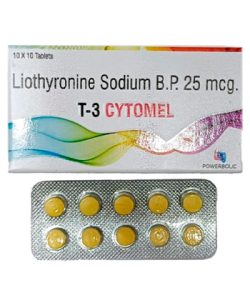
In brief
- Cytomel (liothyronine sodium) is a prescription thyroid medicine, but in some pharmacy settings it may be available without a prescription. It is used for hypothyroidism, certain goitre conditions, and TSH suppression in selected thyroid disorders.
- Cytomel is used to replace or supplement thyroid hormone, acting as a synthetic form of triiodothyronine (T3). It works by binding thyroid hormone receptors and helping regulate metabolism, energy, heart function, and body temperature.
- The usual dose depends on the condition and the patient. In adults, treatment often starts at 25 micrograms once daily, or 5 micrograms daily in older adults or people with heart disease, with gradual adjustment by a doctor.
- The form of administration is an oral tablet.
- Cytomel starts working quickly, usually within a few hours after taking it, with noticeable clinical effect often appearing on the same day or within 1–2 days.
- The duration of action is about one day, which is why it is generally taken once daily.
- Alcohol should be used with caution, as excess alcohol may worsen heart-related side effects and overall thyroid stability. Moderate alcohol is not specifically contraindicated, but heavy drinking is not recommended.
- The most common side effects are palpitations, nervousness, anxiety, insomnia, sweating, tremor, headache, increased appetite, and diarrhoea.
- Would you like to try Cytomel without a prescription?
Basic Cytomel Information
- INN (International Nonproprietary Name): liothyronine
- Brand names available in Australia: Cytomel; liothyronine sodium tablets may also be listed by strength and salt form depending on the pharmacy supplier
- ATC Code: H03AA02
- Forms & dosages: oral tablets; strengths vary by market, with common international strengths including 5 mcg, 25 mcg and 50 mcg tablets
- Manufacturers in Australia: not specified
- Registration status in Australia: prescription-only medicine; local availability depends on wholesaler supply and pharmacy ordering
- OTC / Rx classification: prescription-only
What Australian Shoppers Usually Face First
If you are trying to get Cytomel in Australia, the first issue is usually not the science, it is supply.
Cytomel is a niche liothyronine sodium product, so it is not something most people will find sitting on a shelf next to levothyroxine at Chemist Warehouse, Priceline, TerryWhite Chemmart, or a local independent.
Many shoppers arrive with a telehealth eScript, having already compared Cytomel with levothyroxine, and then want to know whether a pharmacy can source it quickly and what it will cost privately.
That is a fair question, because liothyronine tablets are prescription-only and global supply can be uneven.
Availability, Prescription Access And Supply Constraints
In practice, access usually depends on whether the pharmacy can special-order stock through its distributor, rather than whether the medicine is on display.
A pharmacist may also need to confirm the strength, because Cytomel is supplied as oral tablets and strengths vary by region.
For some patients, the conversation is about getting a repeat script filled through telehealth, while for others it is about whether the medicine can be sourced at all before the weekend.
In our online pharmacy, Cytomel is available without a prescription, with discreet delivery to Australia in 9-21 days.
What Patients Notice First: Speed, Sensitivity, And Price Pressure
Patients often notice that Cytomel is talked about as a faster-acting T3 thyroid hormone, and that same speed is exactly why it can feel more sensitive than T4-only treatment.
People commonly ask whether they will feel a difference within days, whether the dose is too strong, and whether the price reflects the fact that this is a specialist medicine.
| Common buying pain point | What it usually means in pharmacy terms |
|---|---|
| “My local pharmacy does not stock it” | Special order may be needed |
| “I already use levothyroxine” | The prescriber is usually looking for a T3-specific option |
| “Why is it so expensive?” | Private pricing and limited supply can push the cost up |
| “Can I get it quickly?” | Speed depends on stock, wholesaler access, and courier timing |
Why Some Patients Ask For Cytomel And Others Avoid It
People usually come to Cytomel with a very specific story.
They may say their energy never quite returned on levothyroxine, or that they still had brain fog, low mood, or sluggish mornings despite treatment.
Others have the opposite experience and avoid Cytomel because they have felt palpitations, anxiety, or insomnia on thyroid therapy before.
That split is reflected in real-world reviews: liothyronine/Cytomel has an average rating of 6.6/10 from 99 reviews, with 62% positive and 34% negative experiences.
Reported Benefits In Real-World Use
The most commonly reported positives are improved energy, better mental clarity, and a lift in mood.
Some people describe feeling more functional within a few days, which is part of the appeal of a T3 medication.
For patients who have felt flat on other thyroid treatment, that quick response can be meaningful.
- Energy
- Many users report feeling less tired and more able to get through the day.
- Brain fog
- Some patients say concentration improves and their thinking feels clearer.
- Mood
- A number of reports mention a better mood or less depressive heaviness.
Most Common Complaints And Who Is More Likely To Struggle
The main downside is that Cytomel can feel activating.
That means some patients notice palpitations, anxiety, jitteriness, or insomnia, especially if the dose is too high or increased too quickly.
People with a history of heart rhythm problems or high sensitivity to thyroid hormone often need the closest supervision.
That is why the medicine can be very helpful for one patient and uncomfortable for another.
What Cytomel Is And How It Is Named
Cytomel is the brand name for liothyronine sodium, a synthetic form of the thyroid hormone triiodothyronine, or T3.
On pharmacy listings, it may appear as Cytomel (liothyronine sodium) tablets, followed by the strength.
That naming matters because people often compare brand names, imported listings, and generic liothyronine before ordering.
- INN
- Liothyronine
- Salt form
- Liothyronine sodium
- Dosage form
- Oral tablets
Australian Classification And Regulatory Context
For Australian shoppers, Cytomel should be treated as a prescription thyroid medicine, not an everyday over-the-counter purchase.
Most people will be dealing with an eScript, a private price, and a pharmacy that may need to order stock rather than hand it over immediately.
That is different from common levothyroxine products, which are more familiar and more routinely stocked.
| Patient need | Pharmacy reality |
|---|---|
| Regular thyroid replacement | Levothyroxine is usually first-line |
| Need for T3 replacement | Cytomel may be considered by the prescriber |
| Instant shelf access | Not guaranteed; ordering may be required |
| Subsidy questions | PBS status and local listing should be checked at the pharmacy |
What Cytomel Is Used For
The main indication is hypothyroidism, where the thyroid does not make enough hormone.
It is also used in some settings for simple goitre and for TSH suppression protocols under specialist care.
It is not a weight-loss product, and it should not be used for obesity.
| Use | Typical setting |
|---|---|
| Hypothyroidism | Replacement or supplemental therapy |
| Simple goitre | Thyroid enlargement management |
| TSH suppression | Specialist-directed thyroid protocols |
| Weight loss | Not approved and not appropriate |
How Cytomel Works In The Body
Cytomel is active T3, so it replaces thyroid hormone directly rather than relying on the body to convert T4 into T3 first.
That is why some patients and prescribers see it as more precise and faster acting than levothyroxine alone.
Liothyronine binds to thyroid hormone receptors and influences metabolism, heart rate, temperature control, and brain function.
At the practical level, the big difference is that it can be felt more quickly, but it can also produce higher peaks and lower troughs.
| T4 medicine | T3 medicine |
|---|---|
| Levothyroxine | Cytomel |
| Longer half-life | Shorter half-life |
| Slower, steadier effect | Faster, more activating effect |
Strengths And How The Tablets Are Supplied
Cytomel is supplied as oral tablets only under the brand name described in the source data.
There are no official cream or injectable Cytomel forms in the supplied information.
Strengths vary by market, which is important when a patient sees overseas information and expects the same pack locally.
| Region | Strengths reported | Packaging note |
|---|---|---|
| United States | 5 mcg, 25 mcg, 50 mcg | Oral tablets |
| Canada | 5 mcg, 25 mcg | Oral tablets |
| Netherlands | 12.5 microgram | Oral tablets |
| Malta | 25 micrograms | Oral tablet |
How To Take Cytomel Properly
Most people are told to take Cytomel once daily, usually in the morning.
It is commonly taken on an empty stomach, 30 to 60 minutes before breakfast, with water.
That helps absorption and keeps day-to-day use consistent.
- Take it at the same time each day.
- Separate it from iron and calcium by 4 hours.
- Do not double a missed dose.
- Ask the pharmacist before changing to split dosing.
If a dose is missed, take it when remembered unless the next dose is nearly due.
Who Needs A Lower Starting Dose
Cytomel dosing is highly individualised, and the starting dose depends on age, heart risk, and the reason it was prescribed.
For adults with hypothyroidism, the typical starting dose is 25 micrograms once daily.
For older adults or patients with cardiac disease, the starting dose is much lower, around 5 micrograms once daily.
Children and infants can also be treated, but only under specialist supervision.
| Patient group | Typical starting dose | Usual approach |
|---|---|---|
| Adults | 25 micrograms once daily | Gradual titration |
| Older adults or cardiac patients | 5 micrograms once daily | Very cautious titration |
| Paediatric use | 5 micrograms once daily | Specialist supervision only |
Side Effects, Contraindications, And Caution Groups
The most important safety issue with Cytomel is over-replacement.
When there is too much thyroid hormone effect, people can develop palpitations, sweating, tremor, insomnia, anxiety, weight loss, and heat intolerance.
In more serious cases, thyroid hormone excess can contribute to arrhythmias and other cardiac problems.
- Absolute contraindications
- Uncorrected adrenal insufficiency, untreated thyrotoxicosis, hypersensitivity to the product, and acute myocardial infarction in some product monographs
- Higher-risk groups
- Older adults, people with cardiovascular disease, and people at risk of bone loss
- Pregnancy and breastfeeding
- Use requires specialist judgement; liothyronine is excreted into milk in small quantities
- Palpitations
- Insomnia
- Anxiety
- Heat intolerance
- Tremor
- Sweating
No black box warning was identified in the retrieved data.
Drug Interactions And Supplement Conflicts
The most common pharmacy counselling issue is spacing Cytomel away from minerals and binding agents.
Iron, calcium, antacids containing aluminium, and some cholesterol-binding resins can interfere with thyroid hormone therapy.
That is why patients are usually told to keep a clear gap of at least 4 hours.
It is also important to tell the pharmacist about the full medicine list, because other thyroid medicines and heart medicines can change the overall effect.
- Iron supplements
- Calcium supplements
- Antacids
- Cholestyramine-type binding agents
Cytomel Versus Levothyroxine And Desiccated Thyroid
For most hypothyroidism, levothyroxine is still the standard first-line medicine.
Cytomel is pure T3, while levothyroxine is T4 and desiccated thyroid extract contains both T4 and T3.
The key difference is the hormone curve: levothyroxine is steadier, while Cytomel acts faster and can peak more sharply.
| Feature | Cytomel | Levothyroxine | Desiccated thyroid |
|---|---|---|---|
| Hormone type | T3 only | T4 only | T4 + T3 |
| Onset | Rapid | Slower | Mixed |
| Stability | Less stable | Very stable | Intermediate |
| Routine first-line use | No | Yes | No |
What Recent Research Says About T3 Use
Recent work has focused on sustained-release liothyronine, T4/T3 combination therapy, and selected experimental uses rather than a wholesale change in routine treatment.
A 2024 systematic review and meta-analysis found that combination therapy or desiccated thyroid raised serum T3 and lowered T4, but did not show consistent quality-of-life improvement.
There is also early research in multiple sclerosis, but that remains experimental.
For the average patient, the practical takeaway is that Cytomel still has a place, but it is selective rather than routine.
Buying And Storing Cytomel In Australia
If a pharmacy can supply Cytomel, the next practical questions are price, timing, and storage.
Because it is a niche thyroid medicine, many Australian pharmacies will need to special-order it.
That can mean waiting a few days longer than for a standard repeat prescription.
- Confirm the script is valid and legible.
- Ask whether the pharmacy can order the exact strength.
- Compare private prices before paying.
- Use pharmacist counselling if the dose has changed.
Store tablets away from heat and humidity, which matters in Australian homes and when travelling.
For rural patients, ordering delays can be more common, so planning ahead helps avoid running out.
When To Ask The Pharmacist Or Prescriber
Ask the pharmacist if the strength on the box does not match the script, if the pack looks different from what you expected, or if you are switching from levothyroxine.
Ask the prescriber if symptoms are changing, if palpitations start, or if you are pregnant, breastfeeding, or have a heart condition.
Delivery Across Australia
| City | Region | Delivery time |
|---|---|---|
| Sydney | New South Wales | 9-14 days |
| Melbourne | Victoria | 9-14 days |
| Brisbane | Queensland | 9-14 days |
| Perth | Western Australia | 9-14 days |
| Adelaide | South Australia | 9-14 days |
| Canberra | Australian Capital Territory | 9-14 days |
| Hobart | Tasmania | 9-14 days |
| Darwin | Northern Territory | 9-14 days |
| Gold Coast | Queensland | 9-14 days |
| Newcastle | New South Wales | 9-14 days |
| Wollongong | New South Wales | 14-21 days |
| Geelong | Victoria | 14-21 days |
| Townsville | Queensland | 14-21 days |
| Launceston | Tasmania | 14-21 days |
| Toowoomba | Queensland | 14-21 days |
Final Practical Takeaway
Cytomel is a useful but selective T3 thyroid hormone medicine.
It can help when a prescriber wants direct liothyronine replacement, but it needs careful dosing because the benefit and the side effects can both appear quickly.
For Australian shoppers, the biggest real-world issues are access, supply, and making sure the dose, strength, and medicine name all match the prescription.