Acamprosate
In brief
- In our pharmacy, you can buy acamprosate without a prescription, with discreet delivery available throughout Australia.
- Acamprosate is used to help maintain abstinence in adults with alcohol dependence after detoxification. It works by helping stabilise brain chemistry disrupted by long-term alcohol use, reducing craving and the risk of relapse.
- The usual dose of acamprosate for alcohol dependence is 666 mg three times daily, usually taken as two 333 mg tablets per dose. If you have moderate kidney impairment, the dose may be reduced to 333 mg three times daily.
- The form of administration is an oral enteric-coated or delayed-release tablet, swallowed whole.
- It does not work immediately; the effect usually builds gradually over days to weeks with regular use.
- The duration of action is short per dose, so it must be taken regularly three times a day for ongoing support over months.
- Do not drink alcohol while taking acamprosate. It is designed to support abstinence, and alcohol use can reduce the benefit of treatment.
- The most common side effects are diarrhoea, nausea, abdominal pain, flatulence, headache, dizziness, and itching.
- Would you like to try acamprosate without a prescription?
Basic Acamprosate Information
- INN (International Nonproprietary Name): acamprosate
- Brand names available in Australia: Campral and generic-labelled acamprosate products
- ATC Code: N07BB03
- Forms & Dosages: oral enteric-coated delayed-release tablets, typically 333 mg per tablet
- Manufacturers in Australia: not specified
- Registration status in Australia: prescription-only medicine
- OTC / Rx classification: prescription-only
Acamprosate In Australia: Who Buys It, Where It Sits, And Why People Search For It
People usually do not look for acamprosate the way they look for a headache tablet or a cold sore cream.
They are usually searching after a hard conversation with a GP, an alcohol counsellor, or a pharmacist who has explained that this medicine is part of relapse prevention support.
In Australia, acamprosate is not an over-the-counter shelf item.
It is a prescription medicine used as an anti-craving medicine to maintain abstinence in alcohol dependence, and it sits under ATC code N07BB03 as a drug for treatment of alcohol dependence.
That matters because the buying journey is different from most pharmacy products.
Typical Australian buyers are price-sensitive, want clear pack-size information, and usually trust pharmacist advice before they click “order”.
Many also now use telehealth e-scripts, which makes the process more convenient for regional and metro patients alike.
In practice, the most common reasons for search are alcohol dependence, abstinence maintenance, and relapse-prevention support.
- Prescription-only access through a pharmacy, not an OTC shelf.
- Support for abstinence after someone has already stopped drinking.
- Trust and convenience through pharmacist counselling and e-script fulfilment.
- Price awareness because patients often compare brands and pack sizes.
What Australians Usually Expect Before They Care About The Science
Most patients do not start by asking how the medicine works in the brain.
They usually ask whether it will help them stay off alcohol, whether they can remember three daily doses, and whether it will feel like it is doing anything at all.
That is very normal.
Acamprosate is used to maintain abstinence, and the best results occur as part of a broader psychosocial program, so people often judge it by whether life feels more manageable in the first month.
Some patients describe it as “taking the edge off”, while others say it “didn’t do much for me”.
Both experiences are seen in real-world use.
- Takes the edge off
- A quiet reduction in cravings rather than a strong, noticeable effect.
- Didn’t work for me
- Some people do not notice much benefit, especially if dosing is inconsistent or alcohol use continues.
- What matters in month one
- Staying abstinent, keeping a routine, and using counselling or support alongside the medicine.
The practical challenge is often not the idea of treatment, but the rhythm of treatment.
Multiple daily dosing can be annoying, especially when someone is already juggling work, family, and recovery appointments.
That is why reminders, meal-time dosing, and pharmacy support matter so much.
What Acamprosate Is Called In Australia And Internationally
The WHO International Nonproprietary Name is acamprosate, but in everyday use it is commonly referred to as acamprosate calcium because the marketed form is the calcium salt.
The best-documented brand is Campral.
In some markets you will also see Campral EC or generic-labelled acamprosate calcium products.
| Name Type | Value | Notes |
|---|---|---|
| INN | Acamprosate | WHO-recognised nonproprietary name |
| Marketed form | Acamprosate calcium | Calcium salt used in products |
| Brand recognition | Campral | Best-documented global brand |
| Other naming systems | USAN, JAN, N-acetyl homotaurine, 3-acetamido-1-propanesulfonic acid | Used in scientific or jurisdictional naming systems |
For patients, the simple takeaway is this: the active ingredient name is acamprosate, and the most recognisable brand name is Campral.
That helps when comparing packs at the pharmacy counter or when a telehealth prescriber writes the medicine by its generic name.
Product Formats, Pack Presentation, And What To Expect At The Pharmacy Counter
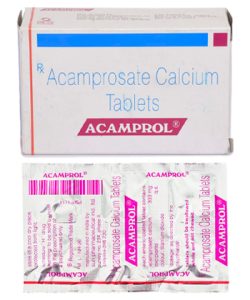
When someone collects acamprosate at a pharmacy, the most important visual cue is usually the tablet itself.
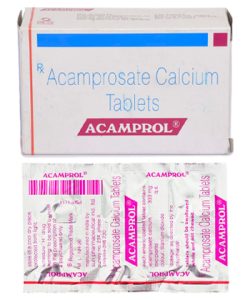
It is typically a white, round, enteric-coated or delayed-release oral tablet marked “333”.
That coating matters because the medicine is designed to release in the gut rather than break down too early.
The standard tablet strength is 333 mg, and the product is commonly supplied in blister packs or bottles depending on the market.
| Feature | Typical Presentation | Why It Matters |
|---|---|---|
| Dosage form | Enteric-coated / delayed-release oral tablet | Protects the medicine until it reaches the gut |
| Strength | 333 mg | Used to build the standard daily dose |
| Tablet appearance | White, round, marked “333” | Helps with pack identification |
| Packaging | Blister packs or bottles | Varies by market and manufacturer |
At the counter, people often ask whether the tablet can be split or crushed.
The practical answer is no: swallow the tablet whole.
The coating is part of the design, and breaking it can affect how the medicine behaves.
If you are comparing brands, the tablet strength and coated form are the key things to check, not just the box name.
What N07BB03 Means In Plain English
ATC code N07BB03 sounds technical, but the breakdown is simple.
It places acamprosate in the nervous system group, then the addictive-disorders group, then the alcohol-dependence subgroup.
So, in plain English, it tells prescribers and pharmacists that this is a medicine used for alcohol dependence support.
- N
- Nervous system
- N07
- Other nervous system drugs
- N07B
- Drugs used in addictive disorders
- N07BB
- Drugs used in alcohol dependence
- N07BB03
- Acamprosate
That classification matters because it reinforces the main clinical use.
It also helps pharmacists spot when a prescription is appropriate and when a patient is asking for the wrong medicine for the wrong condition.
How Acamprosate Helps People Stay Off Alcohol
The patient-friendly version is straightforward.
After long-term heavy drinking, the brain can become overactive when alcohol is stopped.
Acamprosate helps restore balance, which can reduce cravings and support abstinence.
It is not designed to make you sick if you drink, and it is not a withdrawal medicine.
It is a relapse-prevention medicine taken regularly over months.
Simple flow:
Long-term heavy drinking → brain chemistry becomes disrupted → cravings and overactivity during abstinence → acamprosate helps restore balance → better support for staying alcohol-free.
That is why it is usually paired with counselling, rehabilitation, or support groups rather than used on its own.
If someone is expecting an immediate “off switch” for cravings, they can be disappointed.
Acamprosate is better thought of as a steady support medicine.
How The Medicine Works At A Clinical Level
The exact mechanism is not fully established, which is common in addiction medicine.
What is clear is that acamprosate modulates glutamatergic and GABAergic neurotransmission and helps restore the balance between excitation and inhibition in the brain.
| Mechanism Area | What Is Thought To Happen |
|---|---|
| Glutamatergic modulation | May reduce hyperexcitable, hyperglutamatergic abstinence states |
| GABA-related effects | May help restore excitation-inhibition balance |
| Calcium-centred hypothesis | The calcium moiety may be important, but the exact role is still uncertain |
Acamprosate is a synthetic analogue related to GABA and taurine, but it is not fully understood in the same way as a simple pain reliever or antibiotic.
The clinically relevant point is that it supports abstinence in people who have already stopped drinking.
That is why prescribers often focus more on the treatment goal than on the chemistry lesson.
What To Expect Over Days, Weeks, And Months
Acamprosate is not a fast-acting craving suppressant.
Its benefit emerges gradually over weeks, not hours.
That is one of the biggest things patients need to know before starting.
It is taken three times a day, and regular dosing matters far more than using it “as needed”.
Food can reduce bioavailability a little, but standard dosing already accounts for that, and it may still be taken with or without food.
Timeline at a glance:
First few doses: usually no dramatic feeling.
First few weeks: some people notice cravings becoming easier to manage.
After a couple of months: the benefit may feel more obvious, especially if abstinence has been maintained.
Many patients do best when they link the tablets to meals, because that builds routine.
Breakfast, lunch, and dinner is a practical pattern for a lot of Australians.
Who It Is For, And Who It Is Not For
Acamprosate is indicated for the maintenance of abstinence in alcohol dependence or alcohol use disorder.
It is meant for people who are already abstinent at treatment initiation.
That point is important because it is not a detoxification medicine.
| Status | Use | Notes |
|---|---|---|
| Approved use | Alcohol dependence / AUD maintenance treatment | Used with psychosocial support |
| Not approved | Other substance use disorders, depression, anxiety, sleep problems | Not listed as approved indications |
Some clinicians may extend use cautiously to milder alcohol problems or early AUD, but the evidence base is mainly for alcohol dependence and abstinence maintenance.
That is the core clinical lane.
If alcohol is only part of a wider substance-use picture, prescribers still tend to use acamprosate when alcohol is the main target.
Off-Label Use: What Is Discussed And What Is Not Well Supported
People on forums often ask whether acamprosate can help with other addictions, sleep, anxiety, or mood.
Those discussions happen, but the evidence is limited or weak.
Major reviews continue to focus on alcohol dependence only.
Caution point:
Online chatter is not the same as evidence-based prescribing.
In practice, the safest way to think about acamprosate is as an alcohol abstinence support medicine.
That focus keeps expectations realistic and aligns with the evidence.
How To Take It Day To Day
The standard adult dose for alcohol dependence maintenance is 666 mg three times daily.
That means two 333 mg tablets, taken three times a day.
Tablets should be swallowed whole, and they may be taken with or without food.
Starting after detoxification is usual, because the medicine is designed for abstinence maintenance rather than withdrawal management.
| Item | Usual Guidance |
|---|---|
| Standard adult dose | 666 mg three times daily |
| Tablet count | Two 333 mg tablets per dose |
| Tablet handling | Swallow whole |
| Food | With or without food |
| When to start | Usually after detoxification |
In everyday use, the biggest success factor is remembering the doses.
Many patients find phone alarms, blister-pack routines, and mealtime anchors helpful.
If a dose is missed, the usual advice is to take it when remembered unless the next dose is close, and not to double up.
Kidney Function, Dose Adjustments, And Special Populations
Acamprosate is eliminated largely unchanged by the kidneys, so renal function is the main factor for dosing.
That is why kidney checks matter before and during treatment.
| Creatinine Clearance | Recommended Dose | Status |
|---|---|---|
| >50 mL/min | 666 mg three times daily | Standard dose |
| 30–50 mL/min | 333 mg three times daily | Reduced dose |
| <30 mL/min | Do not use | Contraindicated |
Older adults may need extra caution because kidney function is often lower with age.
For liver disease, acamprosate is often attractive because it is not heavily metabolised by the liver, but clinical monitoring is still important.
Breastfeeding is generally a contraindication, and pregnancy requires careful risk–benefit assessment because data are limited.
Use in under-18s is not well established.
That means the decision is usually straightforward in adults, but more nuanced in special populations.
Safety Profile, Side Effects, And Warning Signs
Acamprosate is generally well tolerated, but no medicine is side-effect free.
Diarrhoea is the most frequent adverse effect.
Other common issues include abdominal pain, nausea, vomiting, flatulence, upset stomach, itching, rash, dizziness, headache, insomnia, anxiety, depression, tingling, weakness, and general malaise.
Psychiatric monitoring matters because depression and suicidal thoughts have been reported.
| Type | Examples |
|---|---|
| Common | Diarrhoea, abdominal pain, nausea, vomiting, flatulence, upset stomach |
| Dermatologic | Itch, rash |
| Neurological / psychiatric | Dizziness, headache, insomnia, anxiety, depression, tingling |
| Important warning signs | Depression, suicidal thoughts, severe rash, allergy symptoms |
Safety alert:
If someone develops severe kidney problems, a serious allergic reaction, or suicidal thoughts, the prescriber should be contacted promptly.
Severe renal impairment is a major contraindication.
Breastfeeding is also a contraindication in many product monographs.
As always, the patient’s full medical history matters more than any single leaflet line.
Australian Buying Guide, Alternatives, And Practical Pharmacy Advice
For Australian patients, the buying path is usually script first, then pharmacy fulfilment, then ongoing support.
Telehealth e-scripts have made access easier, especially for people in regional areas or those who want a discreet pharmacy process.
In our online pharmacy, acamprosate is available without a prescription, with discreet delivery to Australia in 9-21 days.
That can be helpful for customers who are already in a treatment plan and need a simple, private ordering process.
Brand comparison is usually between Campral and generic-labelled acamprosate products, with the same active ingredient but varying pack presentation.
When speaking with a pharmacist, the main selection factors are renal function, treatment goal, and whether abstinence or heavy-drinking reduction is the main objective.
| Medicine | Main Goal | Typical Selection Point |
|---|---|---|
| Acamprosate | Maintain abstinence | Often preferred when the goal is complete abstinence |
| Naltrexone | Reduce heavy drinking and craving | Often used when cutting down is the main goal |
| Disulfiram | Enforce abstinence | More suitable in supervised settings |
Acamprosate and naltrexone are both first-line options, while disulfiram is generally a more supervised or second-line choice.
That makes the medicine selection quite practical rather than abstract.
If the patient’s goal is to stay alcohol-free after detox, acamprosate is often a strong fit.
Delivery Across Australia
| City | Region | Delivery time |
|---|---|---|
| Sydney | New South Wales | 9-14 days |
| Melbourne | Victoria | 9-14 days |
| Brisbane | Queensland | 9-14 days |
| Perth | Western Australia | 9-14 days |
| Adelaide | South Australia | 9-14 days |
| Canberra | Australian Capital Territory | 9-14 days |
| Hobart | Tasmania | 9-14 days |
| Darwin | Northern Territory | 9-14 days |
| Gold Coast | Queensland | 9-14 days |
| Newcastle | New South Wales | 14-21 days |
| Wollongong | New South Wales | 14-21 days |
| Geelong | Victoria | 14-21 days |
| Townsville | Queensland | 14-21 days |
| Cairns | Queensland | 14-21 days |
| Ballarat | Victoria | 14-21 days |
Common Questions Australians Ask About Acamprosate
People usually want straight answers, so here are the questions that come up most often in pharmacy conversations.
What is acamprosate used for? It is used to help maintain abstinence in people with alcohol dependence after they have stopped drinking.
Can I drink alcohol while taking it? It is intended to support stopping alcohol use, so alcohol should generally be avoided during treatment.
Do I have to stop drinking before starting? Yes, it is usually started after drinking has already stopped.
How long does it take to work? It usually works gradually over weeks rather than immediately.
Is it addictive? No, it is not considered habit-forming.
Does it harm the liver? It is not known for liver toxicity, but kidney function is important.
Those simple points are often enough for a patient to decide whether to have a proper conversation with their doctor or pharmacist.
If the medicine is part of a broader recovery plan, the chance of staying on track is much better.