Grifulvin V
In brief
- In some pharmacies you can buy Grifulvin V without a prescription, though availability varies by retailer and region; in many countries griseofulvin is officially prescription‑only so check your local pharmacy and regulations.
- Grifulvin V (griseofulvin) is used to treat dermatophyte infections (tinea of the scalp, skin, feet, groin and nails); it works by binding to keratin and disrupting fungal microtubules and mitosis, protecting new skin, hair and nails as they grow.
- Usual doses: adults typically 500 mg–1 g daily (single or divided doses) for skin infections; for children 10–20 mg/kg/day (single or divided); nail infections often require 500 mg–1 g daily for many months (up to 12 months in some cases).
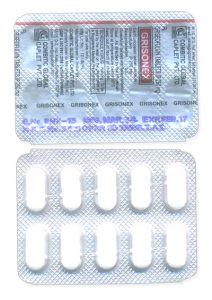
- Forms of administration: oral tablets (commonly 125 mg, 250 mg and in some regions 500 mg) and oral suspension (e.g. 125 mg/5 mL) — take microsize formulations with a fatty meal to improve absorption.
- Onset time: plasma levels are usually reached within 1–4 hours, but clinical improvement can take days to weeks for skin infections and several weeks for scalp infections; nail improvements may not be seen for months.
- Duration of action: antifungal activity is sustained while on treatment and persists in keratinised tissues as they grow — treatment courses range from 2–8 weeks for common tinea, 4–6 weeks for tinea capitis, and months for nail infections.
- Alcohol warning: avoid alcohol during treatment (and for a short time after) because griseofulvin can cause unpleasant disulfiram‑like reactions and increase adverse effects.
- The most common side effect is nausea; other frequent effects include headache, fatigue, dizziness, rash and mild gastrointestinal upset.
- Would you like to try Grifulvin V without a prescription?
Availability & Price Landscape
Basic Grifulvin V Information
- INN (International Nonproprietary Name): Griseofulvin
- Brand Names Available In Australia: Not specified; global brands and trade names include Grifulvin V, Fulvicin P/G, Gris‑PEG, Griseofulvina, Griséofulvine, Griseofulvinum and Amudane.
- ATC Code: D01BA01. Griseofulvin is classified as an oral antifungal for systemic use in the treatment of dermatophytoses.
- Forms & Dosages: Tablets 125mg and 250mg commonly; 500mg tablets in some regions; oral suspension 125mg/5ml in some regions.
- Manufacturers In Australia: Not specified; international suppliers include Aspen Pharmacare, Teva, Amneal and Sun Pharma for generic griseofulvin.
- Registration Status In Australia: Not specified; local TGA registration and sponsor listings should be checked before supply.
- OTC / Rx Classification: Prescription only (Rx) in virtually all regulatory jurisdictions.
National Pharmacy Chains (Chemist Warehouse, Priceline, TerryWhite)
Supply for griseofulvin in Australia is patchy and unpredictable.
Major chains such as Chemist Warehouse, Priceline and TerryWhite Chemmart may list griseofulvin generics intermittently.
Metropolitan stores often rely on special orders rather than keeping stock on the shelf.
Rural pharmacies commonly require two to five day lead times for special orders.
Importers and generic suppliers drive availability, and occasional delistings overseas influence local stock levels.
Pack sizes available from suppliers include tablets 125mg and 250mg, with 500mg tablets and 125mg/5ml oral suspension available in some regions.
Storage and transport sensitivity affects what pharmacies will order; avoid suppliers who cannot guarantee protection from heat and humidity during transit.
- Price drivers: PBS listing or lack of it, importer price, pack size and shipping costs.
- Stock-sourcing checklist: confirm sponsor/importer, batch number, expiry, formulation (microsize/ultramicrosize) and storage assurances.
Online Pharmacy Trends In Australia
Online pharmacies and telehealth e‑prescriptions are commonly used to order Rx antifungals here.
Many online suppliers require script verification before dispatch.
Mail-order routes can be quicker for metropolitan customers but may face extra delays for rural delivery.
Customers often prefer accredited national chains or well‑known telehealth fulfilment services for assurance of authenticity.
Where PBS subsidy does not apply, private‑supply pricing is visible at checkout and varies by pack size and supplier.
Price Ranges By Package Size (PBS Vs Private)
If a griseofulvin product is PBS‑listed the out‑of‑pocket cost will be heavily subsidised.
Where no PBS listing exists or where stock is private‑supply only, prices reflect importer and pack costs and can vary widely between suppliers.
Typical retail differences depend on strength and pack size: smaller packs of 125mg tablets are cheaper per pack but more expensive per mg than larger 250mg or 500mg packs.
Always check the TGA and PBS status before promising a subsidy at the till.
Patient Insights & Satisfaction Levels
Forum Reviews (ProductReview, Aussie Health Forums)
Patients commonly ask, “Will this finally clear my child’s scalp ringworm?” on forums and review sites.
ProductReview and local health forums report a mix of satisfaction and frustration.
Many users praise successful cures for tinea capitis and ringworm after full courses of treatment.
Frequent complaints include side effects and the length of treatment required for scalp or nail infections.
Rural posters often note delays from special orders and reliance on telehealth and mail‑order pharmacies.
Reported Benefits And Issues From Australian Patients
Patients report improved outcomes when tablets are taken with a fatty meal to boost absorption.
Commonly reported side effects include gastrointestinal upset, headaches and photosensitivity.
Some patients split doses to improve tolerability under pharmacist advice.
Practical issues raised include difficulty sourcing the product, multiple pharmacy visits for repeats and private cost when not subsidised.
Peer adherence tips: use calendar reminders, set daily alarms and maintain close follow‑up with your pharmacist for liver‑monitoring advice if on a prolonged course.
- Patient Tips: take with food rich in fat to improve absorption; protect from sunlight; keep to the full course to prevent relapse.
- Short Testimonials: “My child’s tinea capitis cleared after six weeks on tablets taken with milk and toast.”
Product Overview & Brand Variants
INN And Brand Names In Australia
The International Nonproprietary Name is griseofulvin.
Branded griseofulvin products are less commonly marketed in Australia and supply usually comes from imported generics.
International brand names used as references include Grifulvin V, Fulvicin P/G and Gris‑PEG among others.
Available forms referenced for prescribing are tablets 125mg, 250mg, 500mg (some regions) and an oral suspension 125mg/5ml (some regions).
Legal Classification (TGA‑Approved)
Griseofulvin is treated as a prescription‑only medicine in most jurisdictions.
Pharmacies should confirm current TGA registration and sponsor listings before supply.
Product pages must state pack sizes, active ingredient (griseofulvin), excipients where known and manufacturer/importer details when available.
Indications In Local Medical Practice
Approved Uses By TGA
Griseofulvin is used for dermatophyte infections of skin, hair and nails including tinea capitis, corporis, cruris, pedis and onychomycosis.
Australian prescribers commonly prefer alternatives like terbinafine and itraconazole for some indications, but griseofulvin remains important for certain patients.
Off‑Label Patterns In Australian Clinics
Paediatric tinea capitis is a mainstay indication for griseofulvin because of good evidence and established dosing regimens.
Off‑label or situational use occurs in chronic dermatophytoses where alternative agents are contraindicated.
Note that pregnancy is a contraindication due to embryo‑toxicity and teratogenic risk.
Children are dosed weight‑based at 10–20 mg/kg/day and nails require prolonged therapy measured in months.
- Indications Quick List: tinea capitis, tinea corporis, tinea cruris, tinea pedis, tinea unguium (nails).
- Decision Flow: for scalp infection in children favour griseofulvin; for nail infections consider terbinafine or itraconazole depending on patient factors.
How It Works In The Body
Layman’s Explanation
Griseofulvin binds to keratin in skin, hair and nails so the new tissue that grows is resistant to fungal invasion.
The infected tissue is then cleared as healthy keratin replaces the old infected keratin.
Clinical Detail
The drug is absorbed after oral dosing and concentrates in keratinising tissues where it protects new growth from fungal colonisation.
Microsize and ultramicrosize formulations influence absorption and bioavailability.
Taking tablets with a fatty meal improves absorption, particularly for microsize formulations.
Mechanistically, griseofulvin interferes with microtubule function and mitosis in fungal cells, disrupting growth.
It is metabolised hepatically, so caution and monitoring are advised in liver impairment and when interacting medicines are present.
Dosage & Administration
Standard Regimens
Adult dosing varies by condition.
Tinea capitis is usually 500mg to 1g daily in one or two doses for four to six weeks.
Tinea corporis commonly uses 500mg to 1g daily for two to four weeks.
Tinea pedis regimens are often 1g daily for four to eight weeks.
Treatment for onychomycosis may require 500mg to 1g daily for months; fingernails at least four months and toenails at least six months.
Adjustments By Patient Type (Elderly, Chronic Conditions)
Children use weight‑based doses of 10–20 mg/kg/day given once or divided across the day.
Elderly patients require cautious use and monitoring for hepatic or renal impairment.
Formal dose adjustments in liver or renal dysfunction are not well defined, so specialist guidance and closer monitoring are advised.
- Administration Checklist: take with a fatty meal; keep a daily dosing time; set reminders for long courses.
- Missed Dose Advice: take as soon as remembered unless near the next dose; do not double up.
Contraindications & Side Effects
Common
Absolute contraindications include severe hepatic failure, porphyria and known hypersensitivity to griseofulvin or excipients.
Relative contraindications include pregnancy and lactation, history of lupus erythematosus and significant hepatic or renal dysfunction.
Common side effects are gastrointestinal upset, headache, fatigue, dizziness, insomnia, rash and photosensitivity.
Transient hepatic enzyme elevations have been reported.
Rare But Serious (Australian Safety Data)
Rare but serious events include haematologic abnormalities such as leucopenia and granulocytopenia and severe hepatic injury.
Severe hypersensitivity reactions have been reported and require immediate cessation and urgent medical review.
Pharmacies should include clear warnings about pregnancy and recommend liver monitoring for at‑risk patients.
- Stop And Seek Help: severe rash, jaundice or unusual bruising need urgent assessment.
- Monitoring: consider baseline liver history and advise follow‑up during prolonged therapy.
Comparable Medicines
Alternatives Table (PBS And Non‑PBS)
| Medicine | Typical Course Length | PBS Status | Common Adverse Effects |
|---|---|---|---|
| Terbinafine (oral) | 4–12 weeks depending on indication | Often PBS‑listed for specific indications (confirm current schedule) | GI upset, taste disturbance, hepatic effects |
| Itraconazole | 4–12 weeks depending on infection | May be PBS‑listed for some indications | Hepatic effects, drug interactions |
| Fluconazole | Short courses for some skin infections | PBS varies by indication | GI, hepatic enzymes, drug interactions |
Pros And Cons List
- Griseofulvin Pros: effective for paediatric tinea capitis; binds to keratin and protects new tissue.
- Griseofulvin Cons: long treatment courses for nails, gastrointestinal and CNS side effects, teratogenic risk in pregnancy.
- Terbinafine Pros: shorter courses for nail infections and higher nail cure rates in many studies.
- Choice Note: PBS listings change; always confirm subsidy status and clinical suitability.
Current Research & Trends
Major Studies 2022–2025 (Australia + International)
Recent studies focus on comparative effectiveness in paediatric tinea capitis, dermatophyte resistance patterns and safety surveillance alongside newer agents.
Randomised trials tend to favour terbinafine for onychomycosis, while griseofulvin retains evidence for scalp infections in children.
Surveillance data note sporadic declines in availability and shifts toward newer antifungals, supporting the need to keep griseofulvin as a contingency option.
Australian data are limited and up‑to‑date safety signals are best sought via state health departments and TGA adverse‑event reports.
For prescribers and pharmacists, link to systematic reviews and TGA advisories when available and summarise findings in plain language.
Common Patient Questions
FAQs From Australian Pharmacy Consultations
Q: “Can I take griseofulvin in pregnancy?”
A: No. It is contraindicated due to teratogenic risk and counselling about effective contraception is necessary.
Q: “How long until I see improvement?”
A: Superficial skin infections may improve within weeks; scalp and nail infections require months for a full cure.
Q: “Should I avoid sunlight?”
A: Yes. Photosensitivity is possible so advise sun protection and caution with prolonged exposure.
Quick Pharmacist Answers
- Alcohol: avoid heavy alcohol while on therapy; it increases hepatic load.
- Missed Dose: take as soon as remembered unless it is close to the next dose; do not double up.
- Monitoring: verify hepatic history and concomitant meds for interactions before dispensing.
Regulatory Status
TGA Approval
Griseofulvin is generally regarded as a prescription‑only medicine internationally.
Product pages and dispensing records must instruct pharmacists and prescribers to confirm current TGA registration and sponsor listings via the TGA database before supply.
PBS Subsidy Details
PBS subsidy for antifungals varies by indication and sponsor.
Griseofulvin listings on PBS may be limited or regionally variable; check the PBS schedule for current subsidy details.
If a product is not PBS‑subsidised, display clear private pricing and note possible special importation or authorisation routes where applicable.
Visual Recommendations
Infographics: PBS Pricing, Pharmacy Networks
Recommended visuals for product pages include an infographic showing keratin binding and how the drug protects new skin, hair and nails.
Include a dosage table visual for quick reference, a price map for urban versus rural availability and a network diagram showing pharmacy chains and telehealth fulfilment pathways.
Safety badges should highlight pregnancy contraindication, Rx‑only status and storage temperature 20–25°C.
Provide a downloadable counselling PDF and an accessibility‑friendly infographic for low health‑literacy patients.
Buying & Storage Advice
In‑Store Vs Online Purchase Tips In Australia
Always assume a prescription is required and check script verification policies before ordering.
Use reputable national chains or accredited online pharmacies that verify scripts and provide pharmacist counselling.
For rural customers, ask about lead times and how the supplier protects medicines from heat and humidity during transit.
In our online pharmacy, grifulvin v is available without a prescription, with discreet delivery to Australia in 9-21 days.
When buying, verify product authenticity, sponsor/importer details and batch numbers on arrival.
Storage In Australian Household Conditions (Heat/Humidity)
Store griseofulvin at 20–25°C in a dry place and protect from moisture.
Avoid long storage in bathrooms or cars where temperatures and humidity can exceed recommended limits.
Dispense in original packaging or a child‑resistant container when required and include clear expiry and storage instructions on the label.
- Home Storage Tips: keep in a cupboard away from direct sunlight and away from heat sources.
Guidelines For Proper Use
Pharmacist Guidance In Australia
Confirm indication and treatment duration with the prescriber before dispensing.
Verify weight‑based dosing for children at 10–20 mg/kg/day and ensure correct formulation is supplied.
Review pregnancy status and advise contraception for those of childbearing potential.
Check hepatic history and concomitant medicines for interactions and advise on fatty‑meal dosing for better absorption.
Patient Safety Recommendations
Advise patients to stop and seek urgent care for severe rash, jaundice or unusual bruising.
Do not share medication and emphasise the importance of adherence to the full treatment course to reduce relapse risk.
Provide printable counselling scripts and a clear “when to see a doctor” section on the product page.
Delivery Across Australia
| City | Region | Delivery Time |
|---|---|---|
| Sydney | New South Wales | 9-14 days |
| Melbourne | Victoria | 9-14 days |
| Brisbane | Queensland | 9-14 days |
| Perth | Western Australia | 9-14 days |
| Adelaide | South Australia | 9-14 days |
| Hobart | Tasmania | 9-14 days |
| Darwin | Northern Territory | 9-14 days |
| Canberra | Australian Capital Territory | 9-14 days |
| Gold Coast | Queensland | 9-14 days |
| Newcastle | New South Wales | 9-14 days |
| Geelong | Victoria | 9-14 days |
| Wollongong | New South Wales | 9-14 days |
| Cairns | Queensland | 14-21 days |
| Townsville | Queensland | 14-21 days |
| Ballarat | Victoria | 14-21 days |
Final Notes For Pharmacists
Counselling Checklist
Confirm indication and duration before supply.
Verify weight‑based dosing in children (10–20 mg/kg/day).
Screen for pregnancy and advise effective contraception where appropriate.
Review hepatic history and concurrent medications for interactions.
Advise taking with a fatty meal for improved absorption.
Explain photosensitivity risks and recommend sun protection.
Arrange follow up for prolonged courses including consideration of liver function tests or blood counts if clinically indicated.
When To Escalate
Stop treatment and refer immediately for medical assessment if there are signs of severe rash, jaundice, bleeding or marked systemic symptoms.
Report suspected serious adverse reactions through the TGA adverse event reporting system.