Frumil
In brief
- Available from pharmacies and online suppliers; Frumil is classified as a prescription-only medicine in major markets (including the UK, Ireland and NZ), though some pharmacies or online sellers may offer it without a prescription — this is not recommended and may be against local regulations, so always consult a healthcare professional.
- Frumil combines furosemide (a loop diuretic) and amiloride (a potassium‑sparing diuretic) and is used mainly to treat oedema and fluid overload in heart failure and other conditions; furosemide reduces renal sodium and water reabsorption in the thick ascending limb, while amiloride blocks epithelial sodium channels in the distal nephron to help conserve potassium.
- Usual adult dose: one tablet (40 mg furosemide / 5 mg amiloride) each morning; may be increased to two tablets per day (divided AM/noon) if required, with a maximum of 4 tablets/day (maximum amiloride 20 mg/day). Start low in the elderly and adjust for renal/liver impairment under medical supervision.
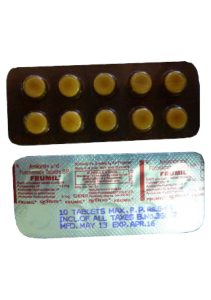
- Oral administration as a scored tablet (orange, marked “FRUMIL”), swallowed with water; tablets may be split at the score if required.
- Onset of effect is usually within 30–60 minutes after an oral dose (furosemide produces diuresis first; amiloride contributes later).
- The diuretic effect typically lasts around 6–8 hours after an oral dose; potassium‑sparing effects from amiloride may persist longer and require monitoring.
- Avoid excessive alcohol while taking Frumil — alcohol can worsen dizziness and low blood pressure and increase dehydration risk.
- The most common side effect is increased urination (diuresis), often accompanied by dizziness, lightheadedness or mild dehydration and potential electrolyte disturbances.
- Would you like to try frumil without a prescription?
Basic Frumil Information
- INN (International Nonproprietary Name): Furosemide (also known as frusemide in some markets) and Amiloride Hydrochloride.
- Brand Names Available In Australia: Not specified.
- ATC Code: C03EB01.
- Forms & Dosages: Tablet, 40 mg furosemide + 5 mg amiloride, oral, scored for splitting.
- Manufacturers In Australia: Not specified.
- Registration Status In Australia: Not specified.
- OTC / Rx Classification: Prescription only (Rx) in major markets; check TGA for local status.
Availability & Price Landscape
National Pharmacy Chains (Chemist Warehouse, Priceline, TerryWhite)
Patients often shop the major chains for the best total cost when filling prescriptions for diuretics.
Chemist Warehouse, Priceline and TerryWhite Chemmart commonly dispense prescription diuretics and run competitive promotions on dispensing fees or private medicines.
Pharmacies differ in margin, dispensing fee and availability of imported brands versus locally supplied generics.
Online Pharmacy Trends In Australia
Urban and rural patients increasingly use telehealth and e-prescriptions to obtain repeats and new scripts for chronic medicines.
Distance supply works well for tablets because prescription verification is straightforward and cold-chain is not required for solid oral dosage forms.
Delivery times and sourcing depend on whether a brand or generic is registered locally or must be imported under special access arrangements.
Price Ranges By Package Size (PBS Vs Private)
If listed on the PBS the patient co-payment will usually be much lower than a private price.
Private prices reflect brand choice, import costs and the pharmacy’s dispensing fee; discount chains may show lower out‑of‑pocket costs than some community pharmacies.
| Price Type | Price | Typical Pack Size | Availability |
|---|---|---|---|
| PBS Price | Not specified | Not specified | Depends on PBS listing |
| Private Price | Not specified | Typically 28 or 30 tablets where supplied | Variable between chains and community pharmacies |
- Checklist: What To Ask Your Pharmacist
- Is this brand TGA-registered or being imported specially?
- What is the total cost including dispensing fee and delivery?
- Will I need blood tests after starting or changing the dose?
- Can this tablet be split to achieve a lower dose?
Patient Insights & Satisfaction Levels
Forum Reviews (ProductReview, Aussie Health Forums)
Patients commonly post about relief from swollen ankles and breathlessness after starting combination diuretics like furosemide plus amiloride.
Reports on ProductReview-style sites and local forums highlight practical issues such as wait times for supply when a product is not on the PBS.
Telehealth users often mention smooth e-prescription workflows when their GP coordinates repeats with a trusted pharmacy.
Reported Benefits And Issues From Australian Patients
Many patients note a rapid reduction in peripheral oedema and easier breathing when a loop diuretic plus a potassium‑sparing agent is prescribed.
Common practical problems mentioned include increased daytime urination and difficulties timing doses to avoid nocturia.
Some describe dizziness on standing and the need for blood tests to check electrolytes after starting therapy.
Top 5 Patient Tips
- Take the tablet in the morning to reduce night-time toilet trips.
- Bring an up‑to‑date medication list to the pharmacy and GP appointments.
- Arrange baseline blood tests within a week of starting and repeat as advised.
- Report new muscle cramps, palpitations or light‑headedness straight away.
- Compare total cost across pharmacies, including delivery if ordering online.
- Questions To Take To Your Pharmacist
- Is this the same as Frumil 40mg/5mg or a different brand with the same actives?
- How often should my electrolytes and kidney function be checked?
- Can I split the tablet safely?
Product Overview & Brand Variants
INN And Brand Names In Australia
The INN is furosemide (frusemide in some markets) plus amiloride hydrochloride.
Internationally Frumil 40 mg/5 mg is an established brand sold in the UK, Ireland and New Zealand in blister packs or bottles.
Local Australian brand names are not specified in the available product data, so always verify the exact product and both active ingredients when dispensing.
Legal Classification (TGA‑Approved)
The combination is prescription only in major markets.
Pharmacists should check the TGA ARTG database for the current registration or sponsor details before supplying a specific brand or generic.
Definitions
- INN: Furosemide + Amiloride Hydrochloride.
- Brand: Frumil (where registered) or equivalent generics.
- Strength: 40 mg furosemide + 5 mg amiloride per tablet.
- Packaging: Blisters or bottles depending on market.
- Prescription Status: Prescription only; verify TGA registration.
Indications In Local Medical Practice
Approved Uses By TGA
Clinicians typically use a furosemide plus amiloride combination for oedema associated with heart failure and cirrhosis with ascites.
Check the TGA register for exact local indications of any marketed product; internationally the combination is used for oedema and heart failure.
Off‑Label Patterns In Australian Clinics
Specialist clinics may use loop diuretic plus potassium‑sparing combinations for resistant oedema where potassium supplements are not suitable.
Off‑label use is guided by specialist supervision with frequent electrolyte and renal monitoring.
Clinical Flowchart
- Clinical Scenario: Significant peripheral or pulmonary oedema → Likely Regimen: Loop diuretic with potassium‑sparing adjunct → Monitoring: Baseline and repeat renal/electrolyte checks within 1–2 weeks.
- Clinical Scenario: Mild oedema or hypertension alone → Likely Regimen: Thiazide or other antihypertensive → Monitoring: Routine as per guideline; consider specialist input before switching to loop diuretics.
How It Works In The Body
Layman’s Explanation
The combination tablet pairs a strong fluid remover (furosemide) with a potassium‑sparing partner (amiloride).
Furosemide makes the kidneys pass more salt and water, which reduces swelling and breathlessness from fluid overload.
Amiloride helps the body retain potassium so that low potassium is less likely than with furosemide alone.
Clinical Detail
Furosemide inhibits the Na‑K‑2Cl cotransporter in the thick ascending limb of the loop of Henle to produce potent diuresis and natriuresis.
Amiloride blocks epithelial sodium channels in the distal nephron, reducing sodium reabsorption and decreasing potassium secretion.
The combination has ATC classification C03EB01, reflecting a loop diuretic paired with a potassium‑sparing agent.
| Drug | Site Of Action | Onset / Effect | Monitoring Needs |
|---|---|---|---|
| Furosemide | Loop Of Henle (thick ascending limb) | Rapid onset, hours | Fluid status, electrolytes, renal function |
| Amiloride | Distal Nephron (ENaC channels) | Slower onset, sustains potassium retention | Serum potassium, renal function |
Dosage & Administration
Standard Regimens
The usual adult starting dose is one tablet (40 mg furosemide + 5 mg amiloride) taken in the morning.
If required, the regimen may be increased to two tablets per day split between morning and midday.
The maximum amiloride dose should not exceed 20 mg per day, which equates to four tablets daily.
Adjustments By Patient Type (Elderly, Chronic Conditions)
Children are not routinely recommended to use this combination unless directed by a specialist.
Elderly patients should start at the lowest effective dose and be titrated cautiously because of comorbidities and increased sensitivity.
Renal impairment: contraindicated in anuria or severe renal failure; use caution in mild to moderate impairment and monitor electrolytes closely.
Liver disease: dose titration and monitoring advised because of theoretical risk of worsening hepatic encephalopathy.
- Dosing Quick Reference
- Start: 1 tablet each morning.
- Increase: Up to 2 tablets/day divided if needed.
- Maximum: Do not exceed 4 tablets/day (maximum amiloride 20 mg/day).
Contraindications & Side Effects
Common
Absolute contraindications include anuria, severe renal failure, hyperkalaemia and known hypersensitivity to furosemide, amiloride or sulfonamide derivatives.
Pregnancy and breastfeeding are contraindications unless the prescriber explicitly evaluates the risk/benefit.
Common side effects include increased urination, mild dehydration and dizziness, particularly when standing.
Rare But Serious (Australian Safety Data)
Serious adverse events to watch for are severe electrolyte disturbances, acute kidney injury, pronounced hypotension and severe hypersensitivity reactions.
Blood test abnormalities may include changes in liver enzymes, cholesterol and triglycerides.
Report suspected adverse reactions to the TGA pharmacovigilance system as per national guidance.
| Symptom | What To Do | When To Seek Urgent Care |
|---|---|---|
| Dizziness On Standing | Stand slowly, sit if lightheaded and discuss dose with your pharmacist or GP. | If fainting or ongoing collapse occurs, seek emergency care. |
| Muscle Cramps Or Palpitations | Arrange blood tests to check electrolytes and potassium. | If severe or associated with weakness, go to emergency. |
| Marked Reduction In Urine Output | Review fluid intake and recent illnesses; contact your GP. | If anuria or rapid deterioration of kidney function occurs, seek urgent care. |
Comparable Medicines
Alternatives Table (PBS And Non‑PBS)
| Active Combination | Typical Use | PBS Status | Key Monitoring |
|---|---|---|---|
| Furosemide + Amiloride (Frumil) | Significant fluid overload, heart failure | Not specified | Electrolytes, renal function |
| Amiloride + Hydrochlorothiazide (Moduretic) | Oedema, hypertension where potassium sparing is desired | Not specified | Electrolytes, renal function, blood pressure |
| Spironolactone + HCTZ (Aldactazide) | Ascites, hyperaldosteronism, oedema | Not specified | Electrolytes, endocrine side effects |
Pros And Cons List
- Frumil (Furosemide + Amiloride) — Pros: Strong loop diuresis for pulmonary and peripheral oedema; built‑in potassium sparing reduces need for supplements.
- Cons: Loop diuretics can cause large fluid shifts and require close monitoring of renal function and electrolytes.
- Moduretic — Pros: Useful when thiazide effect is preferred; potassium‑sparing action included.
- Cons: Less potent than a loop diuretic for significant fluid overload.
- Spironolactone Combinations — Pros: Effective for ascites and hyperaldosteronism.
- Cons: Potential endocrine side effects such as gynaecomastia in some patients.
Current Research & Trends
Major Studies 2022–2025 (Australia + International)
Recent literature has focused on careful dose titration of loop diuretics in heart failure and strategies to balance effective diuresis with electrolyte safety.
There are fewer head‑to‑head trials of fixed furosemide+amiloride formulations; much of the evidence is mechanistic or observational about combined loop and potassium‑sparing approaches.
Australian tertiary centres have emphasised outpatient diuretic clinics, telehealth dosing follow-up and ambulatory monitoring to avoid readmissions.
Key Papers/Guidelines
- Guideline and registry reports promoting pharmacist‑led monitoring and personalised diuretic regimens.
- Observational studies on combining loop diuretics with potassium‑sparing agents to reduce hypokalaemia.
Common Patient Questions (FAQs)
Will Frumil make me pee a lot? Yes; the loop component causes significant diuresis, so morning dosing is recommended to limit nocturia.
Do I need blood tests? Yes; baseline and follow-up renal function and electrolytes, especially potassium and sodium, are essential after starting or changing dose.
Can I split the tablet? The tablet is scored, orange and marked “FRUMIL” and may be split, but confirm with the prescriber if dosing accuracy is critical.
Can I take it with ACE inhibitors or ARBs? These are often used together in heart failure, but combined therapy requires close monitoring for hyperkalaemia and renal function.
Is it on the PBS? Check current PBS listings and discuss subsidy eligibility with your prescriber; private prices vary by pharmacy.
- When To Call Your Pharmacist/GP
- Any new fainting, severe dizziness or fainting spells.
- Muscle weakness, palpitations or severe cramps.
- A marked change in urine output or signs of dehydration.
Regulatory Status
TGA Approval
Internationally the combination is prescription only and registered in countries such as the UK, Ireland and New Zealand.
For Australia, pharmacists must verify the product’s registration by searching the TGA ARTG for the specific product name or active ingredient combination before supply.
PBS Subsidy Details
Subsidy status can change over time; if the combination is listed on the PBS for a defined indication patients will usually pay the PBS co‑payment rather than the full private price.
If not listed the supply will be private and pricing reflects importation and brand choice.
| Regulatory Checkpoint | Value / Status | Pharmacy Action |
|---|---|---|
| TGA ARTG Number | Not specified | Search TGA ARTG before dispensing specific brand |
| PBS Listing Status | Not specified | Confirm PBS status with prescriber and patient eligibility |
Visual Recommendations
Infographics and clear charts help patients understand how the medicine works, what monitoring is required and how pricing compares across channels.
Suggested visuals include a nephron diagram showing loop and distal nephron action, a PBS vs private pricing chart and a prescription‑to‑monitoring patient journey map.
Always include alt text and a local regulatory disclaimer for prescription medicines.
Buying & Storage Advice
In‑Store Vs Online Purchase Tips In Australia
Frumil is prescription only in major markets, so obtain a valid prescription from a GP or via telehealth before ordering.
Use registered Australian pharmacies linked to the e‑prescription system when buying online to ensure prescription verification and safe supply.
In our online pharmacy, frumil is available without a prescription, with discreet delivery to Australia in 9-21 days.
Storage In Australian Household Conditions (Heat/Humidity)
Store below 25°C and protect from moisture and direct sunlight.
Avoid storing tablets in hot, humid places like bathrooms to preserve stability and identification markings.
Keep the product in its original packaging out of reach of children.
- What To Bring To The Pharmacy
- Your current prescription or e‑prescription code.
- A list of current medicines and known allergies.
- Any recent blood test results if available.
Guidelines For Proper Use
Pharmacist Guidance In Australia
Pharmacists should confirm the indication, review interacting medicines such as ACE inhibitors, ARBs, NSAIDs and potassium supplements, and counsel patients on timing and monitoring.
If a product is not TGA‑registered the pharmacist should discuss substitution options and access routes with the prescriber.
Patient Safety Recommendations
Patients should weigh daily if used for heart failure and report rapid weight changes to their clinician.
Arrange blood tests within 1–2 weeks of initiation or dose change and at regular intervals thereafter.
Offer pharmacist‑led monitoring or recall services for ongoing follow up where available.
- Pharmacy Procedural Checklist
- Verify prescription validity and indication.
- Document counseling and arrange monitoring reminders.
- Report suspected adverse effects to the TGA.
Delivery Across Australia
| City | Region | Delivery Time |
|---|---|---|
| Sydney | New South Wales | 9-14 days |
| Melbourne | Victoria | 9-14 days |
| Brisbane | Queensland | 9-14 days |
| Perth | Western Australia | 9-14 days |
| Adelaide | South Australia | 9-14 days |
| Hobart | Tasmania | 9-14 days |
| Canberra | Australian Capital Territory | 9-14 days |
| Gold Coast | Queensland | 9-14 days |
| Newcastle | New South Wales | 9-14 days |
| Wollongong | New South Wales | 14-21 days |
| Sunshine Coast | Queensland | 14-21 days |
| Geelong | Victoria | 14-21 days |
| Townsville | Queensland | 14-21 days |
| Cairns | Queensland | 14-21 days |
| Darwin | Northern Territory | 9-14 days |
Closing Notes
Frumil is a fixed combination of furosemide and amiloride designed to provide potent loop diuresis with potassium‑sparing effects.
Always confirm product registration and PBS status before advising on cost and supply.
Advise patients to arrange baseline and follow‑up blood tests, to take the tablet in the morning and to report symptoms suggestive of electrolyte disturbance or dehydration promptly.
Report any adverse events through the national pharmacovigilance system.