Erythromycin
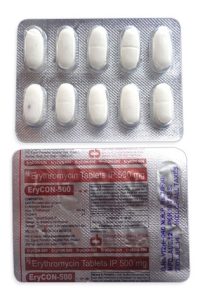
In brief
- In our pharmacy, you can buy erythromycin without a prescription, with delivery in 9–21 days throughout Australia. Discreet and anonymous packaging.
- Erythromycin is used to treat bacterial infections such as respiratory tract infections, skin and soft-tissue infections, acne, and some eye infections. It is a macrolide antibiotic that works by inhibiting bacterial protein synthesis.
- The usual dose of erythromycin depends on the condition and formulation: adults often take 250–500 mg every 6 hours orally, while topical acne treatment is usually 2% applied twice daily.
- The form of administration includes oral tablets, oral suspensions, delayed-release tablets, topical solution or gel, eye ointment, and powder for suspension.
- The effect of the medication usually begins within 1–2 hours after oral dosing, though symptom improvement may take a few days.
- The duration of action is typically several hours per dose, with treatment courses commonly lasting 7–14 days depending on the infection.
- Alcohol is best avoided, as it may worsen stomach upset and can add strain to the liver.
- The most common side effects are nausea, vomiting, abdominal cramps, and diarrhoea.
- Would you like to try erythromycin without a prescription?
Basic Erythromycin Information
- INN (International Nonproprietary Name): Erythromycin
- Brand names available in Australia: Not specified
- ATC Code: J01FA01
- Forms & dosages: Oral tablets 250 mg, 500 mg, 400 mg; oral suspensions 125 mg/5 ml and 250 mg/5 ml; delayed-release tablets 250 mg and 400 mg; topical solution/gel 2%; eye ointment 5 mg/g; powder for suspension 125 or 250 mg/5 ml
- Manufacturers in Australia: Not specified
- Registration status in Australia: Prescription only (Rx) in most jurisdictions; systemic forms are not OTC in most countries
- OTC / Rx classification: Prescription only (Rx) in most jurisdictions
Erythromycin In Australia: What Shoppers Actually Look For At The Pharmacy Counter
People usually ask about erythromycin when a GP, telehealth doctor, or dentist has already decided a macrolide is suitable.
In Australia, that often means a prescription is in hand, a repeat is needed, or a parent is comparing an oral suspension with tablets at a local pharmacy.
Cost matters, but so does whether the product is in stock at the time it is needed.
That is why shoppers compare erythromycin Australia options across big chains, independent pharmacies, and rural dispensaries before they click through.
How Australians Usually Encounter Erythromycin
Most people meet erythromycin through a prescription rather than a shelf display.
It may come via a telehealth eScript, a paper script, or a repeat from a pharmacist who has helped with the same medicine before.
For families outside the major capitals, the question is often whether the nearest pharmacy can source the exact form without delay.
That is especially true for erythromycin prescription requests when the medicine is needed for a child, or when a topical option is preferred for a skin or eye condition.
What Matters Most To Patients
- Cost: patients often ask about erythromycin price before they commit to a fill.
- Availability: stock can vary between metropolitan chains and smaller regional stores.
- Convenience: tablets, oral suspension, and topical products suit different routines.
- Brand trust: familiar erythromycin brand names Australia shoppers recognise can make the handover easier.
- Access: rural customers may need more time for ordering than someone near a CBD pharmacy.
Where Product-Page Detail Helps Most
A clear product page saves time when someone is deciding between erythromycin tablets, an oral suspension, or a topical product.
The form matters because the same active ingredient can be dispensed for very different uses, from short courses for infection to longer acne treatment plans.
What to expect before purchase: check the prescribed form, match the strength on the script, confirm the course length, and ask the pharmacist if the pack size suits the directions.
For shoppers comparing erythromycin 250mg packs, the practical questions are usually about supply, directions, and whether the medicine can be used straight away or needs mixing first.
What Erythromycin Is: Inn, Macrolide Class, And Product Identity
People often want the simple version first.
Erythromycin is a well-known antibacterial medicine, and the name on the box can look slightly different depending on where it is sold.
The basics are easy once the labels are unpacked.
Inn And Class
- INN
- Erythromycin.
- Class
- Macrolide antibacterial.
- Clinical identity
- A prescription antibiotic used in oral, topical, and ophthalmic forms.
Atc Code Explained Simply
- ATC code
- J01FA01.
- J01
- Antibacterials for systemic use.
- FA
- Macrolides.
- 01
- Erythromycin.
When The Name On The Box Varies
Some products are sold under brand names, while others are labelled by the active ingredient only.
That is why erythromycin brand names Australia shoppers search for may not always match the exact packaging seen overseas.
Generic naming can also make the same medicine easier to compare on price, especially when a pharmacist is sourcing an equivalent pack.
Brand Names And Packaging Formats You May See
Different countries use different packaging conventions, so the same medicine may look quite different from one market to another.
That matters when a customer has seen a relative’s pack overseas and assumes the local version should look identical.
| Brand | Region | Form And Strength | Packaging | Manufacturer Or Distributor |
|---|---|---|---|---|
| Erythromycin | USA | Tablet, oral, 250 mg | Tablet | Various |
| Erythromycin | USA | Topical solution, 2% | Topical solution | Various |
| Ilosone | Global/CIPA | Multiple forms, including tablets and suspension | Varies | Cipa et al. |
| E.E.S. 400 | USA | Tablet, 400 mg | Film-coated tablets | Azurity Pharmaceuticals, Carnegie Pharma |
| Akne-Mycin | Europe, USA | Ointment, 20 mg/g | Topical ointment | Coria Laboratories |
| Macin | Bangladesh | Powder for suspension, 125 mg/5 ml | 100 ml bottle | Hallmark Pharmaceuticals Ltd. |
| Mitrocin | Bangladesh | Tablets, 250 mg and 500 mg | Blister packs | Millat Pharmaceuticals Ltd. |
| Makcin | Bangladesh | Powder for suspension, 125 mg/5 ml | 100 ml bottle | Techno Drugs Ltd. |
| Mycin | Bangladesh | Tablet, 500 mg | Blister; 5 x 10 | Ambee Pharmaceuticals Ltd. |
| Ery | Taiwan | Eye ointment, 5 mg/g | Tube | Various |
Manufacturers and distributors include examples such as Azurity Pharmaceuticals, Millat Pharmaceuticals, Hallmark Pharmaceuticals, and other international suppliers.
For Australian shoppers, a pharmacy may supply a locally approved equivalent rather than the exact overseas brand.
That is where erythromycin capsules, tablets, and suspensions need careful matching to the prescription and the pack directions.
Which Erythromycin Forms Are Available And What Each One Is For
When a script arrives, the first question is usually not “what is erythromycin?” but “which form do I actually need?”
That depends on age, the site of infection, and whether the treatment is meant for skin, eye, or oral use.
| Form | Common Strength | Typical Use |
|---|---|---|
| Oral tablet | 250 mg, 500 mg, 400 mg | Systemic treatment for infections |
| Delayed-release tablet | 250 mg, 400 mg | Extended absorption in selected cases |
| Oral suspension | 125 mg/5 ml, 250 mg/5 ml | Paediatric dosing and people who cannot swallow tablets |
| Powder for suspension | 125 or 250 mg/5 ml after reconstitution | Prepared before use for children |
| Topical solution or gel | 2% | Acne and some skin infections |
| Eye ointment | 5 mg/g | Ophthalmic infections |
Oral tablets such as erythromycin 250mg are common when an infection needs systemic treatment.
Oral suspensions are usually the first choice for children because dosing can be matched more closely to body weight.
Topical products and erythromycin ointment are more likely to be discussed for acne or eye use than for a chest infection.
How Erythromycin Is Used In Australian Practice
Shoppers usually want the use case before the chemistry.
That is fair enough, because the pack on the counter has to match the reason it was prescribed.
- Respiratory infections: pharyngitis, bronchitis, and sinusitis may be treated with oral erythromycin.
- Skin and soft tissue infections: tablets are used when an antibacterial course is needed by mouth.
- Acne: erythromycin for acne is a common reason people ask about topical products.
- Eye infections: eye ointment may be used for bacterial conjunctivitis.
- Other prescribed use: some clinicians also use it for gastroprotection in gastroparesis-related situations.
In community pharmacy, acne is one of the most common reasons a customer asks about erythromycin ointment or a 2% topical solution.
For respiratory or skin infections, the conversation usually turns to the exact tablet strength, duration, and whether a child needs a suspension instead.
That is where erythromycin tablets and erythromycin oral suspension are compared in real life, not just on paper.
How Erythromycin Works In The Body
The simplest way to explain it is this: it stops bacteria from making the proteins they need to multiply.
Because bacteria cannot keep building properly, the infection can be brought under control.
Simple picture: erythromycin blocks bacterial protein production, so the organism cannot grow and spread as easily.
Why form matters: oral tablets and suspensions reach the body systemically, while topical and eye products act where they are applied.
That difference is why the same medicine can be used for a chest infection, acne, or an eye infection, depending on the formulation.
For shoppers comparing erythromycin 250mg tablets with a topical product, the route of delivery is just as important as the dose.
Dosage By Condition: What To Expect On A Script
People usually want to know whether the numbers on the box match the directions on the script.
That is especially important when comparing one pack size with another at the pharmacy counter.
| Condition | Usual Form | Typical Dose | Duration |
|---|---|---|---|
| Respiratory infections | Oral tablet | Adults: 250–500 mg every 6 hours; children: 30–50 mg/kg/day in 2–4 doses | 7–14 days |
| Skin and soft-tissue infections | Oral tablet | Adults: 250–500 mg every 6 hours; children: 30–50 mg/kg/day in 2–4 doses | 7–10 days |
| Acne | Topical solution or gel | Apply 2% twice daily | Until improvement |
| Ophthalmic use | Eye ointment | Apply in the affected eye(s) every 6 hours | Typically 7–14 days |
For most infections, the treatment course is often 7–14 days.
Acne and chronic skin problems can run longer, with use guided by the prescriber and response over several weeks.
That is why erythromycin prescription directions should always be checked against the exact pack and the intended form.
Dose Changes For Children, Older Adults, And Liver Or Kidney Issues
Different patients need different levels of caution, even when the medicine itself is the same.
Pharmacists often screen for age, liver history, and other conditions before a pack is handed over.
- Children: suspensions are usually preferred, with dosing based on body weight at 30–50 mg/kg/day divided every 6 to 8 hours.
- Older adults: there is no standard routine dose change, but hepatic function should be monitored.
- Liver impairment: the dose may need to be reduced or the interval extended because erythromycin is metabolised in the liver.
- Kidney impairment: no adjustment is usually needed unless impairment is severe, in which case close monitoring is sensible.
That is the sort of screening that helps a pharmacist spot when a standard pack is fine and when closer review is needed.
It also explains why erythromycin prescription conversations can be more detailed than a simple over-the-counter handover.
Side Effects Patients Notice First
Most people ask about tolerability before they ask about anything else.
That is because side effects are what usually drive a phone call back to the pharmacy.
- Nausea
- Common, especially early in treatment.
- Vomiting
- Can happen alongside stomach upset.
- Abdominal cramps
- Often reported by people taking oral tablets.
- Diarrhoea
- May occur and should be monitored if persistent.
- Rash or irritation
- Can occur with oral or topical use.
- Taste disturbance
- Some patients notice an altered taste.
- Transient hearing loss
- Uncommon, but reported more with high IV or oral doses.
When someone calls the pharmacy about erythromycin tablets, the first practical step is to check whether symptoms are mild and settling, or whether the prescriber needs to be contacted.
Any severe reaction, especially if breathing is affected or the rash is spreading quickly, needs urgent review.
Contraindications And Important Interaction Warnings
This is the safety section that pharmacists pay close attention to.
It is also why medication history questions are asked before dispensing, even when the script looks straightforward.
| Category | Examples | What It Means |
|---|---|---|
| Do not use | Known macrolide allergy; history of cholestatic jaundice or hepatic dysfunction linked to prior use | Erythromycin should not be dispensed in these situations |
| Do not use | Medicines that significantly prolong QT interval or are contraindicated with CYP3A4 metabolism | Major interaction risk |
| Use caution | Hepatic impairment, myasthenia gravis, arrhythmias, prolonged QT | May require closer monitoring or an alternative |
That is why pharmacists ask about the rest of the medicine list, not just the antibiotic being requested.
Interaction screening helps prevent avoidable harm, especially with erythromycin prescription fills where other medicines may already be on board.
Erythromycin Versus Azithromycin Versus Clarithromycin
Customers often ask why one macrolide is chosen instead of another.
That question usually comes up when they have taken one of them before and want the “easier” option this time.
| Medicine | Typical Shopping Point | Why It May Be Chosen |
|---|---|---|
| Erythromycin | Established use and topical options | Useful when the prescriber wants a familiar macrolide or a topical form |
| Azithromycin | Shorter treatment courses | May be preferred for convenience and tolerability |
| Clarithromycin | Alternative macrolide choice | Also favoured in some cases for shorter durations and tolerability |
The practical comparison for a product page is dosing frequency, formulation, and expected gastrointestinal effects.
People comparing erythromycin brand names Australia listings often care less about the label and more about how often the medicine has to be taken.
That is where adherence and day-to-day convenience really shape the final choice.
Australian Availability, Tga Context, And Pbs Realities
Australian buyers usually want to know two things first: can they get it, and what will it cost?
In most jurisdictions, erythromycin is prescription only, and systemic forms are not available over the counter.
That means the usual buying path is a valid script, a pharmacist check, and then local dispensing through a community pharmacy or an eScript fulfilment service.
| Availability | Prescription Status | Likely Purchase Route |
|---|---|---|
| Oral tablets | Prescription only | Community pharmacy or telehealth eScript |
| Oral suspension | Prescription only | Pharmacy ordering or stock on hand |
| Topical products | Prescription only in most settings | Pharmacy supply after script review |
| Eye ointment | Prescription only | Pharmacy dispensing with clinical check |
PBS versus private pricing can change the final bill, and the pack size or strength can also alter what a patient pays.
That is why erythromycin price questions are often best answered after the script details are checked.
In our online pharmacy, erythromycin is available without a prescription, with discreet delivery to Australia in 9-21 days.
Storage, Transport, And Handling In Australian Homes
Heat and humidity matter in Australian homes, especially over summer.
That is why the storage directions on the box should be followed carefully.
- Tablets and capsules: store below 25°C and protect from moisture.
- Suspensions: refrigerate after reconstitution if the label says so, and shake before use.
- Topicals: keep at room temperature and avoid freezing.
- Eye ointment: store below 25°C and discard after the course is finished.
Families often forget that a bottle left in a hot car can be just as troublesome as one stored in a steamy bathroom cabinet.
That is especially relevant for erythromycin oral suspension, which may need extra care once mixed.
Safe Use Checklist: Missed Doses, Overdose, And Pharmacist Advice
Missed doses are common, especially with medicines taken several times a day.
What matters is what happens next, not the fact that a dose was missed.
- Missed dose: take it as soon as remembered unless it is nearly time for the next dose.
- Do not double up: taking two doses at once does not make up for the missed one.
- Overdose: seek medical attention immediately if too much has been taken.
- Overdose symptoms: gastrointestinal upset and possible ototoxicity in high doses.
- Finish the course: do not stop early unless a pharmacist, GP, or prescriber says to.
- Ask for help: severe side effects, allergy, suspected interaction, or worsening symptoms need review.
A quick pharmacy call can save a lot of trouble if the directions are unclear or the pack seems wrong for the prescription.
That is especially true with erythromycin 250mg packs, where timing and total tablet count need to line up with the prescribed schedule.
When in doubt, a pharmacist or GP review is the safest next step.
Delivery Across Australia
| City | Region | Delivery Time |
|---|---|---|
| Sydney | New South Wales | 9-14 days |
| Melbourne | Victoria | 9-14 days |
| Brisbane | Queensland | 9-14 days |
| Perth | Western Australia | 9-14 days |
| Adelaide | South Australia | 9-14 days |
| Canberra | Australian Capital Territory | 9-14 days |
| Hobart | Tasmania | 9-14 days |
| Darwin | Northern Territory | 9-14 days |
| Gold Coast | Queensland | 9-14 days |
| Newcastle | New South Wales | 9-14 days |
| Wollongong | New South Wales | 9-14 days |
| Geelong | Victoria | 9-14 days |
| Townsville | Queensland | 14-21 days |
| Albury | New South Wales | 14-21 days |
| Bunbury | Western Australia | 14-21 days |
Trusted Registration And Product Details At A Glance
Before choosing a pack, shoppers often want the key details in one place.
This is where product identity, strength, and the most important safety points are easiest to check.
- INN: Erythromycin.
- ATC code: J01FA01.
- Common forms: tablets, oral suspension, delayed-release tablets, topical solution or gel, eye ointment, powder for suspension.
- Main use cases: respiratory infections, skin and soft tissue infections, acne, ophthalmic infections.
- Key safety point: prescription screening matters because of allergy and interaction risks.
For the latest public registration information, national regulatory agency records remain the best reference point.
That includes erythromycin ANMDMR approval checks overseas and local registration checks for other markets.
Closing Notes For Australian Shoppers
Erythromycin remains a familiar macrolide option, but the right form matters just as much as the active ingredient.
Tablets, suspensions, topical solutions, and eye ointments all serve different jobs, so the label has to match the script.
For shoppers comparing erythromycin Australia options, the real decision points are usually price, stock, pack size, and how quickly the medicine can be supplied.
When the prescription is clear and the pack is matched properly, the pharmacy handover becomes much simpler.
That is exactly what most customers want at the counter: the right medicine, the right strength, and no surprises.