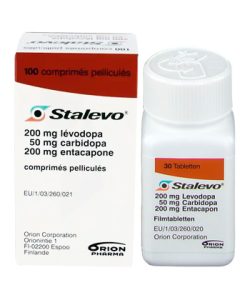
Stalevo
In brief
- Some pharmacies or online vendors may offer Stalevo without a prescription and provide delivery within Australia, but Stalevo is legally a prescription-only medicine in Australia and most other countries and should be used under medical supervision.
- Stalevo is used to treat Parkinson’s disease in adults experiencing motor fluctuations (“wearing off”); it combines levodopa (a dopamine precursor), carbidopa (a dopa‑decarboxylase inhibitor that reduces peripheral conversion of levodopa) and entacapone (a COMT inhibitor that prolongs levodopa’s effect).
- The usual dosing is matched to the patient’s current levodopa/DDCI regimen; commonly one tablet per dose taken 3–7 times daily as needed for symptom control. Available strengths contain levodopa 50–200 mg (Stalevo 50/75/100/125/150/200) with corresponding carbidopa and 200 mg entacapone; do not exceed 200 mg levodopa per dose or about 2000 mg/day.
- Form of administration: oral film-coated tablet (brown, oval tablets).
- Onset time: typically starts to work within about 20–60 minutes after oral administration, though this varies with gastric emptying and individual factors.
- Duration of action: effects commonly last around 3–6 hours per dose (entacapone helps prolong levodopa’s effect and reduce “off” time), but duration varies by dose and patient.
- Alcohol warning: avoid excessive alcohol—alcohol can worsen side effects (dizziness, sedation) and may interact with Parkinson medicines; discuss alcohol use with your prescriber.
- The most common side effec is nausea (other frequent effects include diarrhoea, dyskinesia, urine discolouration, dizziness/orthostatic hypotension and insomnia).
- Would you like to try “stalevo” without a prescription?
Basic Stalevo Information
- INN (International Nonproprietary Name): Levodopa, Carbidopa, Entacapone.
- Brand Names Available In Australia: Stalevo is supplied in Australia as Stalevo, presented as brown, oval film-coated tablets in boxed blister packs and is supplied by Novartis/Orion.
- ATC Code: N04BA03 (levodopa combinations).
- Forms & Dosages: Film-coated tablets for oral use; all strengths include 200 mg entacapone with the following levodopa/carbidopa amounts: 50/12.5/200, 75/18.75/200, 100/25/200, 125/31.25/200, 150/37.5/200, 200/50/200.
- Manufacturers In Australia: Novartis / Orion (national subsidiaries handle local packaging and distribution).
- Registration Status In Australia: TGA-registered and marketed as a prescription-only medicine for Parkinson’s disease with motor fluctuations.
- OTC / Rx Classification: Prescription Only Medicine (Rx).
Availability & Price Landscape
Many people ask where Stalevo is stocked and what it costs in Australia.
Major national pharmacy chains such as Chemist Warehouse, Priceline and TerryWhite Chemmart typically stock Stalevo and hospital pharmacies can supply it too.
Urban outlets generally have higher availability of common strengths, while regional and remote stores may need to order specific levodopa strengths such as 50–200 mg variants.
Stalevo is supplied in blister-packed boxed film-coated tablets from manufacturers including Novartis and Orion.
Online pharmacy use is common for Parkinson’s medicines; many Australians use telehealth e‑prescriptions and upload scripts for pharmacist review before dispatch.
Discount retailers frequently advertise competitive private prices but Stalevo usually requires an uploaded prescription and pharmacist authorisation prior to supply.
Rural customers should be aware there is sometimes a delay in supply despite courier services and repeat prescriptions sent via major chains.
Price Ranges By Package Size (PBS Vs Private):
| Pack Size | Typical Strength | PBS Subsidised Price | Private Retail Price (Approx.) |
|---|---|---|---|
| 30 | Stalevo 100 (100/25/200) | Varies by concession and PBS listing — check current PBS schedule | Varies by retailer; discount chains may offer lower private prices |
| 30 | Stalevo 200 (200/50/200) | Varies by formulation and patient status — confirm on PBS | Typically higher than PBS price when not subsidised |
Always check the current PBS schedule and your concession status before purchase to confirm exact subsidy and patient co‑payment.
Patient Insights & Satisfaction Levels
Patients commonly want to know whether Stalevo actually reduces wearing‑off and simplifies treatment.
Australian forum and review sites frequently report improved “on” time after switching from levodopa plus a DDCI alone to the triple combination.
Many patients and carers praise the single‑tablet approach compared with taking separate levodopa, carbidopa and entacapone tablets.
Pharmacists often get thank‑you notes from patients who appreciated counselling on expected brown urine discolouration and how to match dosing times.
Reported clinical benefits include smoother motor control and fewer OFF episodes for a large number of patients.
Commonly reported issues are an initial increase in nausea, orthostatic dizziness, occasional increased dyskinesia and startling brown urine colouration.
Rural patients sometimes report stock‑outs and delayed repeat supplies and therefore rely on telehealth scripts and large chain deliveries to maintain continuity.
- Top 5 Patient‑Reported Pros: Fewer wearing‑off episodes, longer “on” time, simpler pill regimen, clearer pharmacist counselling on side effects, more predictable dosing.
- Top 5 Patient‑Reported Cons: Initial nausea, increased dyskinesia in some, dizziness/orthostatic hypotension, urine discolouration (benign), occasional supply delays in rural areas.
Product Overview & Brand Variants
People often ask what exactly is inside each Stalevo tablet and what strengths are available locally.
The INN components are levodopa, carbidopa and entacapone, commonly abbreviated LCE in clinical notes.
In Australia the primary marketed brand is Stalevo, presented as brown, oval film‑coated tablets in multiple strengths.
Every marketed Stalevo tablet contains 200 mg entacapone with varying levodopa and carbidopa amounts depending on the strength.
Below is a quick reference list of marketed strengths and exact composition:
- Stalevo 50: 50 mg levodopa / 12.5 mg carbidopa / 200 mg entacapone.
- Stalevo 75: 75 mg levodopa / 18.75 mg carbidopa / 200 mg entacapone.
- Stalevo 100: 100 mg levodopa / 25 mg carbidopa / 200 mg entacapone.
- Stalevo 125: 125 mg levodopa / 31.25 mg carbidopa / 200 mg entacapone.
- Stalevo 150: 150 mg levodopa / 37.5 mg carbidopa / 200 mg entacapone.
- Stalevo 200: 200 mg levodopa / 50 mg carbidopa / 200 mg entacapone.
Stalevo is TGA‑approved and sold under licence to Novartis/Orion for Australian supply.
Indications In Local Medical Practice
Clinicians and patients frequently want clarity on when Stalevo is recommended.
The TGA‑approved indication is for adults with Parkinson’s disease who experience motor fluctuations or “wearing off” despite standard levodopa plus DDCI therapy.
Initiation in Australia is typically done by matching the patient’s current levodopa/DDCI dose and titrating to the closest Stalevo tablet.
Off‑label use is uncommon but does occur when clinicians prefer to simplify pill burden or when early entacapone is expected to stabilise motor response.
Changes are usually coordinated between the GP, neurologist and pharmacist to ensure correct dose‑matching and monitoring.
| Standard Indications | Observed Off‑Label Patterns | Typical Monitoring Checkpoints |
|---|---|---|
| Motor fluctuations despite levodopa/DDCI. | Pill‑burden simplification; earlier addition of entacapone to smooth response. | Blood pressure (orthostasis), mood and behaviour, dyskinesia assessment. |
Monitoring is important during the first weeks after switching and periodically thereafter.
How It Works In The Body
People usually want a simple explanation of how Stalevo improves movement.
Stalevo combines levodopa, which is converted into dopamine in the brain, with carbidopa, which prevents peripheral breakdown so more levodopa reaches the brain, and entacapone, which prolongs levodopa levels.
The combined effect is smoother dopaminergic delivery and usually longer “on” periods with fewer motor fluctuations.
Clinically, entacapone inhibits catechol‑O‑methyltransferase (COMT) in the periphery, reducing peripheral methylation of levodopa and increasing its bioavailability.
The ATC classification is N04BA03 and the therapeutic aim is fewer OFF episodes and more predictable motor control.
Because every tablet contains 200 mg entacapone, the levodopa/carbidopa ratio varies by strength and this is relevant when titrating doses to symptom response.
Dosage & Administration
Common patient questions include how to start and how often to take Stalevo.
Initiation involves matching to the patient’s current levodopa/DDCI schedule and moving to the nearest Stalevo strength.
Maintenance dosing is often one tablet per dose, taken 3–7 times daily according to symptom control.
The maximum per dose should not exceed 200 mg levodopa and daily levodopa‑equivalent guidance suggests not exceeding around 2,000 mg per day depending on the product monograph.
Elderly patients should start on a lower dose and titrate slowly due to increased sensitivity and fall risk from orthostatic hypotension.
Renal impairment requires careful monitoring for adverse effects and dose adjustments where necessary.
Hepatic impairment is more significant for entacapone exposure and avoidance or dose reduction may be required.
Practical points: keep dosing times consistent, consider timing with meals because protein can interfere with levodopa absorption and avoid abrupt discontinuation.
- Pharmacy Dosing Checklist: Confirm current levodopa/DDCI dose, select nearest Stalevo strength, advise maximum per dose, instruct on meal timing and monitoring plan.
Contraindications & Side Effects
Patients expect to hear what side effects to expect and what is absolutely unsafe.
Common adverse effects seen in Australian practice include nausea, diarrhoea, dyskinesia, dizziness or orthostatic hypotension, insomnia and benign brownish urine discolouration.
Pharmacists should proactively counsel that the urine colour change is expected and harmless to avoid alarm.
Absolute contraindications are known hypersensitivity to any component, narrow‑angle glaucoma, severe liver disease and pheochromocytoma.
Serious but less common risks include severe behavioural changes or psychosis, neuroleptic malignant‑like reactions on abrupt withdrawal, and significant cardiac arrhythmia in overdose.
Advise immediate medical review for severe confusion, persistent vomiting or cardiac symptoms.
Pharmacist Warning Box: Check for severe liver disease, history of psychosis, and concurrent use of non‑selective MAO inhibitors before supply.
Comparable Medicines
People often compare Stalevo with other levodopa formulations and COMT strategies.
| Product | Components | Role | PBS Notes |
|---|---|---|---|
| Sinemet | Levodopa / Carbidopa | Standard levodopa/DDCI without COMT inhibitor. | Common PBS listing for many strengths; check schedule. |
| Madopar | Levodopa / Benserazide | Alternative DDCI partner to levodopa with different kinetics. | PBS status varies by formulation. |
| Comtan | Entacapone (monotherapy adjunct) | Given alongside separate levodopa/DDCI to add COMT inhibition. | Available; used when separate titration of entacapone is preferred. |
Pros of Stalevo include simplification to a single tablet and consistent entacapone dosing that often reduces wearing‑off.
Cons include a fixed 200 mg entacapone dose that limits fine‑tuning and entacapone‑related adverse effects, plus potentially higher private cost if not PBS‑subsidised.
Current Research & Trends
Clinicians ask about the latest evidence for combination therapies including levodopa/carbidopa/entacapone.
Major studies from 2022–2024 examine real‑world effectiveness of combination therapies, long‑term dyskinesia risk and comparative strategies versus adding entacapone separately.
Australian registry data and international cohort analyses generally report that adding entacapone prolongs on time and reduces off episodes for many patients.
Research trends emphasise adherence benefits from single‑tablet combinations, personalised dosing algorithms and integration with device‑assisted therapies.
Ongoing work also looks at polypharmacy risks in older adults and hepatic or renal safety signals that can influence clinical decisions.
Practical implications for pharmacists include monitoring for dyskinesia over time and counselling on long‑term safety alongside neurologists.
Common Patient Questions
- Will Stalevo change my urine colour?
Yes — brownish urine is common and benign; reassure patients.
- Can I drive on Stalevo?
Not until motor function and side effects such as drowsiness or dizziness are stable; advise individual assessment.
- What if I miss a dose?
Take as soon as remembered but do not double the next dose; resume the regular schedule.
- How does it compare to Sinemet?
Stalevo adds entacapone to levodopa/DDCI which often prolongs “on” time; discuss pros and cons with the neurologist or pharmacist.
- Is it on the PBS?
PBS status can vary by strength and indication — check the current PBS schedule or ask a pharmacist at point of sale.
Regulatory Status
Consumers and prescribers want to confirm national approval and subsidy details.
Stalevo is TGA‑approved in Australia as a prescription medicine for Parkinson’s disease with motor fluctuations, aligning with EMA and FDA approvals.
The manufacturer/distributor for Australian supply is listed as Novartis/Orion in the registration data.
PBS listings and subsidy levels vary by formulation and patient concession status and can change over time.
Pharmacists should verify the current PBS schedule and patient entitlement during consultations to determine subsidy eligibility.
Patients with concession cards may receive different PBS pricing compared with general patients and some may elect to purchase privately via discount chains.
Visual Recommendations
Good visuals help patients and carers understand strengths, dosing and storage.
Suggested product page infographics: a tablet strengths chart showing levodopa/carbidopa/entacapone values, a PBS vs private price bar chart, a simple mechanism‑of‑action diagram, and a pharmacy network map highlighting urban versus rural stock availability.
Prefer visual blocks such as a photo of the brown oval film‑coated Stalevo tablet, a blister pack close‑up, a warning icon for contraindications and a quick checklist card for pharmacist counselling.
Use clear alt text such as “Stalevo 100 25 200 tablet” for accessibility and SEO.
Buying & Storage Advice
People want practical tips for ordering, especially if they live outside major cities.
For in‑store purchases bring a current prescription and any PBS concession card to the pharmacy.
For online orders via major chains confirm that the e‑prescription upload process is complete and that pharmacist counselling is available by phone.
In our online pharmacy, stalevo is available without a prescription, with discreet delivery to Australia in 9-21 days.
Rural customers should allow extra delivery time and consider arranging repeat supplies with a local hospital pharmacy as a backup.
Compare private prices across verified pharmacies but prioritise safety and pharmacist review over price alone.
Storage tips: store below 30°C and protect from moisture and light in the original blister pack and box.
During hot, humid Australian summers avoid storing tablets near cooktops or in cars and keep them in a cool, dry cupboard.
Delivery Across Australia
| City | Region | Delivery time |
|---|---|---|
| Sydney | New South Wales | 9-14 days |
| Melbourne | Victoria | 9-14 days |
| Brisbane | Queensland | 9-14 days |
| Perth | Western Australia | 9-14 days |
| Adelaide | South Australia | 9-14 days |
| Canberra | Australian Capital Territory | 9-14 days |
| Hobart | Tasmania | 9-14 days |
| Darwin | Northern Territory | 9-14 days |
| Gold Coast | Queensland | 9-14 days |
| Newcastle | New South Wales | 9-14 days |
| Wollongong | New South Wales | 14-21 days |
| Geelong | Victoria | 14-21 days |
| Cairns | Queensland | 14-21 days |
| Townsville | Queensland | 14-21 days |
Guidelines For Proper Use
Pharmacists play a key role in making sure Stalevo is used safely and effectively.
Confirm the patient’s current levodopa/DDCI dosing and ensure appropriate dose matching before switching to Stalevo.
Counsel patients on urine discolouration, orthostatic precautions, common GI side effects and how to manage missed doses.
Check for drug interactions, including concurrent non‑selective MAO inhibitors, and review psychiatric history for psychosis risk.
Provide a written dosing schedule and offer medication reminders or dose organisers for complex regimens.
Patient safety recommendations include advising when to seek urgent care for severe confusion, persistent vomiting or signs of hepatic dysfunction.
Encourage reporting of adverse events to the pharmacist, treating neurologist and via the TGA adverse event reporting system.
Quick pharmacist red flags: severe liver disease, severe psychosis, unexplained autonomic instability and overdose signs such as severe dyskinesia or arrhythmia.