Colofac
In brief
- Available from community pharmacies and online pharmacies; in Australia Colofac (mebeverine) is usually a prescription-only medicine (TGA), although in some countries and some pharmacies small packs are sold OTC and some online vendors may supply without a prescription — availability varies, so check your local pharmacy.
- Colofac is used for relief of abdominal pain, cramps and bowel irregularity in irritable bowel syndrome (IBS); mebeverine is an antispasmodic that acts directly on gut smooth muscle to reduce spasms without prominent systemic anticholinergic effects.
- Usual adult dose: 135 mg tablet three times daily, or 200 mg modified‑release capsule twice daily. Not generally recommended for children under 10; usual adult doses are normally used in the elderly unless otherwise advised.
- Form of administration: oral — standard tablets (135 mg), prolonged‑release capsules (200 mg) and an oral liquid formulation for those with swallowing difficulties.
- Onset time: many people notice symptom relief within 30–60 minutes, though individual response varies.
- Duration of action: symptom relief typically lasts several hours; the 200 mg modified‑release capsule provides prolonged effect (up to about 12 hours); treatment duration depends on symptoms and may continue for weeks to months under medical supervision.
- Alcohol warning: avoid or limit alcohol while taking Colofac as alcohol can worsen dizziness and gastrointestinal irritation and may increase side effects.
- The most common side effects are mild gastrointestinal symptoms (heartburn, indigestion, diarrhoea or constipation) and sometimes headache or dizziness; allergic reactions are rare.
- Would you like to try colofac without a prescription?
Basic Colofac Information
- INN (International Nonproprietary Name): Mebeverine.
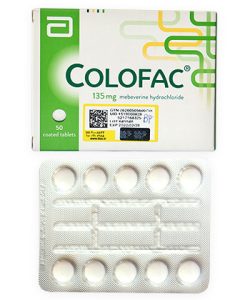
- Brand Names Available In Australia: Colofac® — tablets 135 mg, blister packs of 30 or 500.
- ATC Code: A03AA04 — drugs for functional gastrointestinal disorders, synthetic anticholinergic esters with tertiary amino group.
- Forms & Dosages: Standard tablets 135 mg (1 tablet three times daily); prolonged-release capsules 200 mg (1 capsule twice daily); oral liquid (equivalent to tablets) for swallowing difficulties.
- Manufacturers In Australia: Mylan Australia (now part of Viatris) listed among suppliers.
- Registration Status In Australia: TGA-registered.
- OTC / Rx Classification: Prescription only in Australia.
Availability & Price Landscape
Where can you realistically find Colofac in Australia?
Colofac (INN: mebeverine) is sold locally as Colofac® 135 mg tablets in blister packs of 30 or 500.
National pharmacy chains such as Chemist Warehouse and Priceline routinely stock Colofac, while independent banner pharmacies including TerryWhite Chemmart may carry smaller packs.
Because Colofac is TGA-registered as prescription-only in Australia, purchases usually follow a GP or telehealth e-prescription and many clinics can e-prescribe directly to pharmacy chains.
Online pharmacy trends in Australia favour telehealth-linked e-prescriptions, click-and-collect and home delivery for chronic IBS management.
Colofac is not commonly PBS-subsidised, so most sales are private-pay and out-of-pocket cost varies by retailer and pack size.
Larger blister packs reduce per-tablet cost, which is why some patients order the 500-tablet pack when clinically appropriate.
Discount pharmacies run promotions on private prescriptions from time to time but exact prices are not specified here.
Table: price-by-pack-size across major chains — values not specified in supplied data.
| Retailer | Pack Size | Price (AUD) |
|---|---|---|
| Chemist Warehouse | 30 / 500 | Not specified |
| Priceline | 30 / 500 | Not specified |
| TerryWhite Chemmart | 30 | Not specified |
| Online Pharmacies | 30 / 500 | Not specified |
Online Pharmacy Trends In Australia
Telehealth scripts paired with same-day dispatch in metro areas are increasingly common for chronic IBS patients.
Click-and-collect and tracked courier delivery are standard options for continuity of care and discretion.
Rural patients often prefer mail-order repeat prescriptions to avoid long GP or pharmacy trips.
Some pharmacies offer generics or larger pack options to reduce per-tablet cost for long-term therapy.
In our online pharmacy, Colofac is available without a prescription, with discreet delivery to Australia in 9-21 days.
Price Ranges By Package Size (PBS Vs Private)
PBS coverage for Colofac is uncommon in Australia, so most patients pay privately.
Where PBS subsidy does not apply, cost depends on retailer pricing and available discounts rather than a standard PBS rate.
Bulk packs (500 tablets) generally offer better per-tablet value than 30-tablet packs, though total upfront cost is higher.
Pharmacists can advise on generic mebeverine availability and bulk-pack options to reduce overall cost burden.
Patient Insights & Satisfaction Levels
What do Australians say about Colofac?
Patient feedback appears on ProductReview, health forums and social media groups where users describe symptom changes in daily life.
Many report meaningful reduction in cramping and visceral pain when taking mebeverine at standard regimens such as 135 mg three times daily.
Positives commonly mentioned include fewer spasms, better day-to-day comfort and less drowsiness than older antimuscarinic agents.
Negatives include incomplete relief of bloating or altered bowel habit and variable time to effect, ranging from days to weeks.
Occasional gastrointestinal side effects such as heartburn or constipation are reported, but overall adverse events seem uncommon.
Rural patients often buy larger packs to reduce repeat visits when GP appointments are harder to get.
Cost sensitivity drives many Australians to discount chains or to ask about generic mebeverine options.
- Pros: Good tolerability, reduced cramping, non-habit forming.
- Cons: May not relieve bloating or bowel habit changes fully; onset can be slow.
Product Overview & Brand Variants
What exactly is Colofac in Australia?
INN: mebeverine, marketed locally as Colofac® 135 mg tablets in blister packs of 30 or 500.
Internationally, other brands and formulations exist such as Duspatalin® and Colofac® modified-release 200 mg capsules and oral liquids in some markets.
Local manufacturing or supply is associated with Mylan Australia, now part of Viatris, among other global suppliers.
Regulatory status is clear: Colofac is TGA-registered and classified as prescription-only in Australia.
This legal classification affects supply models and PBS listing, because small-pack OTC sales available in some EU countries do not apply here.
Quick Reference:
- INN: Mebeverine.
- Brand: Colofac® 135 mg tablets.
- Strengths: 135 mg tablets; MR 200 mg capsules available internationally.
- Pack Sizes: 30 or 500 tablets in Australia.
- Legal Status: Prescription only (TGA).
Indications In Local Medical Practice
When do Australian clinicians prescribe Colofac?
TGA-approved indications centre on relief of abdominal pain and cramps caused by irritable bowel syndrome and functional gut spasms.
GPs and gastroenterologists commonly use mebeverine for IBS-associated cramping and pain after structural pathology is excluded.
Off-label uses in practice include adjunctive treatment for non-specific gut spasm or spasm-related pain in other functional bowel disorders while diagnostics continue.
Use in pregnancy and breastfeeding is cautious and generally avoided unless the prescriber judges benefits to outweigh risks.
Approved Vs Common Off-Label Indications:
| Indication | Status |
|---|---|
| IBS-related abdominal pain and cramps | Approved (TGA) |
| Non-specific gut spasms or functional bowel spasm adjunct | Common Off-Label |
| Symptom control pending diagnostic work-up | Common Off-Label |
How It Works In The Body
How does mebeverine relieve cramps without the heavy side effects?
In plain terms, mebeverine relaxes the smooth muscle of the gut to reduce painful spasms and cramping without producing marked systemic anticholinergic effects.
Patients typically report relief of sharp cramp-like abdominal pain and improved comfort between bowel motions.
Clinically, mebeverine is classified under ATC A03AA04 as a synthetic anticholinergic ester with a tertiary amino group.
Despite that classification, it lacks pronounced systemic antimuscarinic effects, which explains its favourable tolerability profile in people sensitive to anticholinergic adverse events.
The mechanism appears to be a direct smooth muscle relaxant action and possible modulation of gut motility and visceral sensitivity.
Onset varies between patients, and adherence to dosing schedules — 135 mg three times daily or 200 mg MR twice daily — supports consistent symptomatic control.
Mechanism → Symptom: Smooth Muscle Relaxation → Reduced Cramping and Visceral Pain.
Dosage & Administration
What dose should a typical adult take?
Standard adult dosing in Australia uses the 135 mg tablet taken three times daily.
Internationally available prolonged-release 200 mg capsules are taken twice daily where that formulation is used.
Take tablets with water and aim for consistent timing; taking doses with meals can help patients remember routines.
If a dose is missed, take it as soon as remembered unless it is close to the next scheduled dose and do not double up.
Children under 10 are generally not recommended to take mebeverine because safety and efficacy data are limited.
Elderly patients usually use standard adult dosing unless clinical conditions require caution.
Severe hepatic or renal impairment calls for careful use though formal dose adjustments are not established.
Review treatment after a few weeks and seek medical review if symptoms persist after two weeks.
Contraindications & Side Effects
Who should not take mebeverine and what adverse effects should be watched for?
Absolute contraindications include known hypersensitivity to mebeverine or excipients and known paralytic ileus.
Certain formulations containing sugars are contraindicated in hereditary galactose intolerance, Lapp lactase deficiency or glucose-galactose malabsorption.
Relative caution is needed in severe liver or kidney impairment, acute porphyrias, pregnancy and breastfeeding — avoid unless clinically necessary.
Common side effects are generally rare but include mild gastrointestinal symptoms such as heartburn, indigestion, diarrhoea or constipation.
Central nervous system effects reported include dizziness, headache and tiredness.
Immune reactions like rash or urticaria can occur and require immediate cessation and medical review.
Very rare serious events listed include drug-induced angle-closure glaucoma and false-positive amphetamine results on some urine drug screens.
- Immediate Action: Stop the medicine and seek urgent care for signs of allergic reaction such as facial swelling or breathing difficulty.
- For Mild Effects: Discuss symptoms with a pharmacist or prescriber before continuing therapy.
Comparable Medicines
What are reasonable alternatives if Colofac is unsuitable or ineffective?
Common antispasmodic alternatives include dicycloverine (dicyclomine/Bentyl®), hyoscine butylbromide (Buscopan®), peppermint oil (Colpermin®) and alverine citrate (Spasmonal®).
Differences to note: mebeverine tends to have minimal systemic anticholinergic activity, which is helpful for patients troubled by dry mouth or blurred vision from other agents.
Hyoscine and dicycloverine provide stronger antimuscarinic effects but carry a higher risk of anticholinergic side effects.
Peppermint oil acts via a smooth muscle relaxant effect and can help with bloating in some patients.
| Molecule | Brand | PBS Status | Main Advantages | Common Adverse Effects |
|---|---|---|---|---|
| Mebeverine | Colofac® | Generally Private | Low anticholinergic burden, well tolerated | GI upset, rare rash |
| Dicycloverine | Bentyl® | Varies | Effective antispasmodic | Dry mouth, blurred vision |
| Hyoscine Butylbromide | Buscopan® | Varies | Rapid relief of cramping | Anticholinergic effects |
| Peppermint Oil | Colpermin® | Private | Works for bloating in some | Heartburn in sensitive patients |
Pros and Cons Summary:
- Colofac: Pros — tolerability, non-habit forming; Cons — limited effect on bloating alone.
- Peppermint Oil: Pros — helps bloating; Cons — may cause heartburn.
Current Research & Trends
What’s the recent evidence say about antispasmodics and mebeverine?
Recent studies from 2022–2025 continue to examine antispasmodics within multimodal IBS care, comparing symptom relief and tolerability across agents and against non-pharmacological measures.
Australian practice increasingly emphasises symptom-directed prescribing, matching treatment to pain-predominant or bowel-habit-predominant presentations.
Head-to-head tolerability comparisons often favour mebeverine for having a lower anticholinergic burden than dicyclomine or hyoscine.
Systematic reviews report modest effect sizes for antispasmodics overall but consistent pain relief in a subset of participants.
Real-world audits are looking at telehealth-driven repeat prescribing patterns in rural populations and how larger pack dispensing affects continuity of care.
Clinical guidance still supports combining dietary measures such as low FODMAP approaches and psychological therapies with targeted pharmacotherapy for best outcomes.
For busy prescribers a short evidence-summary box helps: modest benefit for abdominal pain, good tolerability profile, best used within a broader management plan.
Common Patient Questions
Here are the questions patients ask most at the pharmacy counter.
How fast does Colofac work?
Some patients notice symptom reduction within days, while others may need weeks; seek review if no improvement after about two weeks.
Can I use it long-term?
Yes, under medical supervision it can be used long-term and it is not considered habit-forming.
Is it safe in pregnancy or breastfeeding?
Data are limited so it is generally avoided unless the prescriber judges it necessary; discuss risks with your clinician.
Does it interact with other medicines?
No major interactions are reported but always check with a pharmacist for individual medication reviews.
Where do I get a repeat script?
Repeats are available from your GP, telehealth services or specialists and pharmacies can advise on local e-prescribing and discount options.
When to seek urgent care: severe abdominal pain, fever, persistent vomiting or bloody stools require immediate medical review.
Regulatory Status
What are the formal Australian regulatory details?
Colofac (mebeverine) is TGA-registered and classified as prescription-only in Australia.
Registration covers symptomatic relief of IBS-related abdominal pain and gut spasms and enforces labelling of doses and contraindications.
PBS listing is not common for Colofac, so most patients pay privately unless a specific concessional circumstance applies.
Pharmacists should discuss patient assistance options, generic alternatives and bulk-pack pricing to help reduce costs.
Regulatory Checklist:
- TGA Status: Registered.
- Prescription Classification: Prescription only.
- Local Supplier: Mylan Australia / Viatris.
Visual Recommendations
Which visuals help patients decide and pharmacists counsel efficiently?
Recommended infographics include a flowchart from symptoms to GP or telehealth, then to e-prescription and pharmacy dispatch.
A clear pricing comparison table for 30 vs 500 packs across Chemist Warehouse, Priceline and TerryWhite with per-tablet cost highlighted aids buying decisions.
A contraindication quick-card using alert icons for hypersensitivity, paralytic ileus and sugar-intolerance formulations improves safety counselling.
A dosage timeline visual contrasting 135 mg tds with 200 mg MR bd and an expected review at two weeks helps set expectations.
Always include alt-text and concise captions for accessibility and printable patient leaflets for the product page.
Buying & Storage Advice
How should Australians buy and store Colofac?
Because Colofac is prescription-only, ensure a valid GP or telehealth e-prescription before purchasing in Australia.
For chronic use consider discussing a larger blister pack (500) with your prescriber to reduce pharmacy visits if clinically appropriate.
Compare prices across Chemist Warehouse, Priceline and local independents before you buy.
Telehealth-linked pharmacies in metro areas often dispatch same-day while rural customers may prefer tracked mail-order delivery.
Storage guidance: keep in original blister packaging below 25°C, protect from moisture and light, and store out of reach of children.
Avoid storing medicine in bathrooms or cars during hot, humid Australian summers; use a cool, dry cupboard instead.
Always check the expiry date before use.
Guidelines For Proper Use
What should a pharmacist cover at counselling and what should patients watch for?
Pharmacists should confirm diagnosis, rule out red flags and explain dosing clearly — 135 mg three times daily for standard tablets.
Set realistic expectations about onset, typically days to weeks, and advise on side effects and absolute contraindications such as paralytic ileus.
Document allergies and concurrent medicines and flag patients undergoing urine drug screening about rare false-positive amphetamine results.
Recommend medical review if severe abdominal pain, fever, persistent vomiting or bloody diarrhoea develops or if symptoms persist after two weeks.
For long-term users schedule periodic reviews to assess efficacy and adverse effects.
Encourage complementary lifestyle measures like low FODMAP dietary changes and stress management as part of a multi‑modal plan.
Provide a printable checklist or leaflet summarising dosing, red flags and storage for patient reference.
Delivery Across Australia
| City | Region | Delivery Time |
|---|---|---|
| Sydney | New South Wales | 9-14 days |
| Melbourne | Victoria | 9-14 days |
| Brisbane | Queensland | 9-14 days |
| Perth | Western Australia | 9-14 days |
| Adelaide | South Australia | 9-14 days |
| Canberra | Australian Capital Territory | 9-14 days |
| Hobart | Tasmania | 9-14 days |
| Darwin | Northern Territory | 14-21 days |
| Gold Coast | Queensland | 9-14 days |
| Newcastle | New South Wales | 14-21 days |
| Wollongong | New South Wales | 14-21 days |
| Geelong | Victoria | 14-21 days |
| Cairns | Queensland | 14-21 days |
| Townsville | Queensland | 14-21 days |
| Sunshine Coast | Queensland | 14-21 days |