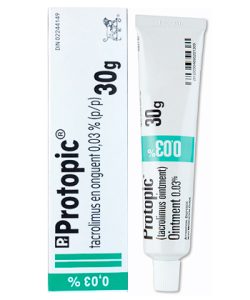
Protopic
In brief
- Protopic is officially a prescription‑only medicine in virtually all markets, but availability varies — some pharmacies or online suppliers may supply tacrolimus ointment without asking for a prescription or receipt; purchasing without a prescription may be unlawful or unsafe depending on your location.
- Protopic (tacrolimus ointment) is used to treat moderate‑to‑severe atopic dermatitis; it is a topical calcineurin inhibitor that reduces T‑cell activation and inflammatory cytokine release in the skin.
- Usual dosing: apply a thin layer to affected areas twice daily — adults may use 0.03% or 0.1% ointment (0.1% commonly for ≥16 years), children 2–15 years use 0.03% only; discontinue when skin clears and consider maintenance once or twice weekly to prevent flares.
- Form of administration: topical ointment applied to the skin; do not apply to mucous membranes, open wounds or under occlusive dressings.
- Onset time: some patients notice symptom relief within a few days, with clearer improvement commonly seen within 1–3 weeks of treatment.
- Duration of action: symptom control is maintained while treatment continues; maintenance dosing once or twice weekly can reduce recurrences — long‑term use has been studied for up to several years in selected patients.
- Alcohol warning: alcohol is not strictly prohibited, but avoid drinking alcohol immediately after application as it can cause local flushing or increased sensitivity in some people.
- The most common side effect is a transient burning or stinging sensation at the application site (also itching, redness and mild irritation are common).
- Would you like to try “protopic” without a prescription?
Availability & Price Landscape
Basic Protopic Information
- INN (International Nonproprietary Name): Tacrolimus.
- Brand Names Available In Australia: Protopic (available in USA, EU, Japan and others); Tacrolimus Sandoz (EU); Talimus (India); Prograf (oral/injection — not topical).
- ATC Code: D11AH01.
- Forms & Dosages: Ointment 0.03% (children ≥2 years and adults) and ointment 0.1% (adults and adolescents ≥16 years); common tube sizes include 30g and 60g.
- Manufacturers In Australia: not specified.
- Registration Status In Australia: not specified.
- OTC / Rx Classification: Prescription only (Rx) in virtually all markets.
Worried about where to buy Protopic and how much it will cost?
National pharmacy chains such as Chemist Warehouse, Priceline and TerryWhite Chemmart are common first stops for prescription medicines.
These retailers typically stock brand Protopic and may be able to order generics or alternate brands if required.
Online pharmacy trends in Australia now include telehealth e-prescriptions, click-and-collect and home delivery.
Rural access depends on local dispensing and courier time, so stock and delivery windows matter for country customers.
PBS subsidy status can change, so confirm current PBS listing at official portals before assuming a subsidy applies.
Private prices vary widely by brand, tube size and discounting retailer, with Protopic often priced higher than generics when purchased privately.
The following table summarises typical retail touchpoints rather than exact prices.
| Retailer | Brand / Generic | Common Size | Price | Postage |
|---|---|---|---|---|
| Chemist Warehouse | Protopic / Possible generics | 30g, 60g | Private pricing varies by promotion | Varies by location |
| Priceline | Protopic / Order-in generics | 30g | Private pricing varies | Varies by location |
| TerryWhite Chemmart | Protopic / Local stock | 30g, 60g | Private pricing varies | Varies by location |
| Online Pharmacy (e-prescription) | Protopic / Generic Ointment | 30g | Private pricing varies; compare retailers | Delivery fees apply |
Checklist For Ordering:
- Have a current prescription or telehealth e-prescription ready.
- Bring photo ID if collecting in store or if retailer requires it.
- Confirm tube strength (0.03% or 0.1%) and size before payment.
- Ask about PBS subsidy eligibility and whether an authority prescription is needed.
- Check expected delivery or click-and-collect time if living in a rural area.
Patient Insights & Satisfaction Levels
Forum Reviews (ProductReview, Aussie Health Forums)
Are people in Australia getting fast relief with tacrolimus?
Online reviews on ProductReview and health forums often highlight rapid reduction in itch and visible inflammation for flares, especially on sensitive areas such as the face and eyelids.
Many reviewers praise tacrolimus as a steroid-free option and for its steroid‑sparing role in ongoing management.
Complaints focus on transient burning or stinging on application and occasional local irritation.
Rural posters often mention courier delays or intermittent stock shortages at local pharmacies.
Satisfaction rises when a pharmacist or GP provides clear application advice and realistic expectations for onset of effect.
Reported Benefits And Issues From Australian Patients
What do patients say are the main pros and cons in real life?
Benefits reported include effective itch control, good inflammation reduction on delicate skin and a lower risk of atrophy compared with topical steroids.
Common issues include burning on application for the first days, the need for repeat prescriptions and cost concerns for private buyers.
Many patients report better adherence when shown how to apply a thin layer twice daily and when maintenance pulses are explained.
| Benefits | Common Complaints |
|---|---|
| Steroid-free management; suitable for face/eyelids | Transient burning/stinging; local irritation |
| Useful as part of steroid-sparing strategies | Cost and need for repeat prescriptions |
Real Patient Highlights:
- “It stopped the itch on my eyelids within days” — typical forum comment about tacrolimus for eczema Australia.
- “Burning settled after three days when told to expect transient stinging” — example of counselling improving satisfaction.
- “Had to wait for courier to a rural town” — common rural access note.
Product Overview & Brand Variants
INN And Brand Names In Australia
Want to know what Protopic actually is?
The International Nonproprietary Name (INN) is tacrolimus.
Protopic is the best-known brand in many markets and the topical formulation is available as ointment 0.03% and 0.1% in tubes.
Other brands internationally include Tacrolimus Sandoz and Talimus, while Prograf is an oral/injectable tacrolimus product not for dermatology use.
Legal Classification (TGA-Approved)
Is tacrolimus available over the counter?
Topical tacrolimus is classified as prescription only (Rx) in virtually all markets according to available data.
Check the Therapeutic Goods Administration (TGA) database and PBS listings for current Australian registration or subsidy details before advising patients that a specific product is on the PBS.
Product pages should display concentration and typical tube sizes (for example, 30g and 60g) so customers order the correct strength.
Indications In Local Medical Practice
Approved Uses By TGA
When do Australian clinicians prescribe tacrolimus?
Topical tacrolimus is used for atopic dermatitis (moderate to severe cases) and for flares at sensitive sites where steroid-induced atrophy is a concern.
Label dosing matches the 0.03% formulation for children aged two years and older and the 0.1% formulation for adults and adolescents aged 16 and above.
Local practice aligns with the approved age ranges and the use of tacrolimus after standard therapies have failed or when steroid-sparing is desirable.
Off-Label Patterns In Australian Clinics
Are there off‑label uses seen in specialist clinics?
Dermatologists may sometimes use tacrolimus off‑label as an adjunct for conditions such as vitiligo or seborrhoeic dermatitis, with informed consent and documentation.
Pharmacists should flag patients who are immunocompromised or who have active skin infections as these are contraindications.
Quick Referral Checklist:
- Refer back to GP or dermatologist if the patient is under 2 years old and tacrolimus is being considered.
- Refer if there are signs of active skin infection (herpes, varicella, bacterial infection).
- Refer if persistent irritation or suspicious skin lesions develop while on treatment.
How It Works In The Body
Layman’s Explanation
How does tacrolimus calm an eczema flare without being a steroid?
Tacrolimus is a topical calcineurin inhibitor that reduces local immune overactivity in the skin, which cuts down redness and itch.
Applied to the affected area, it modifies T‑cell signalling and calms the inflammatory response without causing steroid-type skin thinning.
Clinical Detail
What happens at the cellular level?
Chemically, tacrolimus binds to FK506 binding proteins (FKBP) and inhibits calcineurin phosphatase.
This prevents activation of NF‑AT transcription factors and reduces cytokine production by T lymphocytes.
Systemic absorption from topical use is generally minimal, though caution is advised on very thin or broken skin due to potential increased absorption.
- Definition: Calcineurin inhibitor — drug class that blocks calcineurin to reduce T‑cell activation.
- Definition: FKBP — intracellular binding proteins that tacrolimus targets to exert effect.
- Definition: NF‑AT — transcription factor involved in cytokine gene expression.
Dosage & Administration
Standard Regimens
How should patients apply tacrolimus for best results?
Apply a thin layer to the affected areas twice daily until clear, which commonly takes one to three weeks.
When lesions clear, stop application; for maintenance, apply once or twice weekly to previously affected areas to reduce relapses.
Adults may use 0.03% or 0.1% ointment twice daily.
Children aged 2–15 years should use 0.03% ointment twice daily only.
Adjustments By Patient Type
Do elderly patients need dose changes?
Routine dose adjustments are not required for elderly patients or those with renal or hepatic impairment due to minimal systemic exposure.
Monitor fragile or very thin skin in older adults for irritation.
- Step 1: Apply a thin film to affected areas twice daily until clear.
- Step 2: Wash hands after application unless treating the hands.
- Step 3: Avoid eyes and mucous membranes; do not apply to open wounds.
- Step 4: For maintenance, apply once or twice weekly to previous lesions as advised by GP.
| Age Group | Strength | Frequency |
|---|---|---|
| Children 2–15 years | 0.03% | Twice daily |
| Adolescents ≥16 years | 0.1% | Twice daily |
| Adults | 0.03% or 0.1% | Twice daily; maintenance once or twice weekly |
Contraindications & Side Effects
Common
What common side effects should be counselled for?
Very common effects include transient burning or stinging at the application site, itching, redness and skin tingling.
Less common effects reported include folliculitis, herpes simplex reactivation and acneiform eruptions.
Contraindications include known hypersensitivity to tacrolimus or ointment excipients such as mineral oil or paraffin.
Rare But Serious (Australian Safety Data)
When should therapy be stopped and medical review sought?
Label warnings note a theoretical malignancy risk, so monitor for suspicious or non‑healing lesions and refer to dermatology as needed.
Avoid use in immunocompromised patients (for example post‑transplant or those on systemic immunosuppressants) and in active skin infections such as varicella or herpes simplex.
Stop treatment and seek medical attention if severe allergic reaction occurs.
| Frequency | Adverse Events |
|---|---|
| Very Common / Common | Burning/stinging, itching, erythema, flushing |
| Less Common | Folliculitis, herpes simplex, viral skin infections |
| Moderate / Uncommon | Theoretical malignancy risk; monitor suspicious lesions |
Checklist: Stop and seek review for persistent severe irritation, signs of systemic infection, or new suspicious skin lesions.
Comparable Medicines
Alternatives Table (PBS And Non-PBS)
What are reasonable alternatives when tacrolimus is unsuitable or unavailable?
| Medicine | Mechanism | Typical Use | PBS Status | Common Adverse Effects |
|---|---|---|---|---|
| Topical Corticosteroids (hydrocortisone, betamethasone) | Anti-inflammatory via glucocorticoid receptors | First-line for many flares | Varies by formulation | Skin thinning with prolonged use |
| Elidel (pimecrolimus) | Topical calcineurin inhibitor | Steroid-sparing for sensitive areas | Varies | Burning, irritation |
| Crisaborole (Eucrisa) | PDE4 inhibitor | Mild-to-moderate atopic dermatitis | Varies | Local irritation |
Pros And Cons List
Which strengths make tacrolimus preferable or less desirable?
- Pros: Steroid-free, low risk of skin atrophy, suitable for face and eyelids, useful for maintenance pulses.
- Cons: Transient burning, cost for private buyers, prescription requirement in most jurisdictions, caution in immunocompromised patients.
Current Research & Trends
Major Studies 2022–2025 (Australia + International)
What recent evidence should pharmacists be aware of?
Recent studies continue to support tacrolimus for maintenance therapy and steroid‑sparing regimens, with safety surveillance showing minimal systemic absorption in standard topical use.
Long-term observational cohorts report safety data extending up to several years in selected groups.
Comparative trials examine tacrolimus against topical steroids and newer agents such as PDE4 inhibitors to define optimal niche use.
Emerging Practice Patterns
How has practice changed in Australian clinics recently?
Telehealth prescriptions and online dispensing have grown, and clinicians increasingly recommend maintenance once- or twice-weekly dosing to prevent relapses.
Cost-conscious switching between brand and generics is common where PBS subsidy is not available.
- Timeline Highlight: 2022–2023 studies reinforced efficacy for maintenance therapy.
- Timeline Highlight: 2024 observational data continued to show negligible systemic absorption in typical use.
- Timeline Highlight: 2025 practice trend shows rising telehealth-driven prescriptions and online pharmacy delivery.
Common Patient Questions
FAQs From Australian Pharmacy Consultations
How fast will Protopic work?
Itch may improve within days, while visible improvement usually occurs over one to three weeks.
Is tacrolimus a steroid?
No; tacrolimus is steroid-free and carries a much lower risk of skin thinning compared with topical corticosteroids.
Can my child use it?
Yes, 0.03% is approved for children aged two years and older; follow GP dosing advice.
Can I use it on my face?
Yes, the ointment is commonly used on sensitive areas, but avoid eyes and mucous membranes.
What about sun exposure?
Minimise UV exposure during treatment and report any unusual or persistent lesions.
Missed dose guidance: Apply as soon as remembered and do not double the next dose.
Storage: Store below 25°C, do not freeze and keep the tube tightly closed.
Regulatory Status
TGA Approval
Is tacrolimus approved by the TGA in Australia?
Registration specifics should be confirmed on the TGA public portal since available international data indicate the topical formulation is prescription only in most markets.
Pharmacists should link product pages to the TGA or SPC for the most current registration and safety notices.
PBS Subsidy Details
Can patients rely on PBS subsidy?
PBS listing can change and depends on indication and authority requirements, so verify current eligibility and documentation required for concession claims.
- Documentation For Subsidy Claims: valid prescription, concession card if applicable, any required authority approval.
- Note: Confirm PBS status via official PBS portals before advising on subsidy availability.
Visual Recommendations
Infographics: PBS Pricing, Pharmacy Networks
Which visuals help customers understand Protopic access and use?
Recommend a price comparison infographic showing private vs PBS cost ranges with clear alt text and links to official sources.
Include a diagram of the patient journey: prescription → dispensing → delivery or click-and-collect.
Provide a step-by-step application pictogram (thin layer, twice daily, wash hands) and an adverse-effect timeline (immediate burning then follow-up signs).
Buying & Storage Advice
In-Store Vs Online Purchase Tips In Australia
Should patients buy in store or online?
Both are viable; require a current prescription for standard dispensing.
For telehealth e-prescriptions, confirm the receiving pharmacy accepts the e-script format and check delivery windows before ordering.
Compare national chains for price and availability, and ask about stock and delivery windows if living rurally.
In our online pharmacy, protopic is available without a prescription, with discreet delivery to Australia in 9-21 days.
Storage In Australian Household Conditions (Heat/Humidity)
How should Protopic be stored in warm, humid homes?
Store below 25°C away from direct sunlight and do not freeze the tube.
Avoid storing in bathrooms where heat and humidity vary; choose a cool cupboard or an air‑conditioned room.
Check the pack or leaflet for shelf-life and typical post‑opening use period (often 12 months after opening).
Guidelines For Proper Use
Pharmacist Guidance In Australia
What should pharmacists cover during counselling?
Confirm contraindications such as immunocompromised status or active skin infection before dispensing.
Check the patient’s age to ensure the correct strength is supplied and document counselling in patient records.
Explain application technique, expected onset and maintenance dosing and advise when to seek medical review.
Patient Safety Recommendations
What practical safety tips should patients follow?
Avoid occlusive dressings and do not apply to open wounds or mucous membranes.
Advise against concurrent use of potent topical steroids without clinician approval.
Recommend GP or dermatology follow-up for severe or unusual reactions and urgent care for signs of systemic infection or severe allergic reaction.
- Counselling Checklist: confirm prescription, demonstrate thin application, advise on burning and when to stop.
- Patient Handout Template: strength, application steps, storage, warning signs and follow-up instructions.
Delivery Across Australia
| City | Region | Delivery Time |
|---|---|---|
| Sydney | New South Wales | 9-14 days |
| Melbourne | Victoria | 9-14 days |
| Brisbane | Queensland | 9-14 days |
| Perth | Western Australia | 9-14 days |
| Adelaide | South Australia | 9-14 days |
| Canberra | Australian Capital Territory | 9-14 days |
| Hobart | Tasmania | 9-14 days |
| Darwin | Northern Territory | 9-14 days |
| Gold Coast | Queensland | 9-14 days |
| Newcastle | New South Wales | 9-14 days |
| Geelong | Victoria | 14-21 days |
| Cairns | Queensland | 14-21 days |
| Townsville | Queensland | 14-21 days |
| Wollongong | New South Wales | 14-21 days |