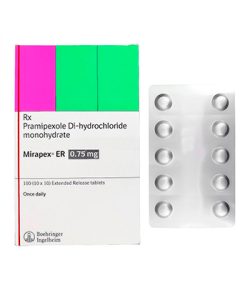
Mirapex
In brief
- In our pharmacy you can buy mirapex without a prescription, with discreet packaging and delivery across Australia.
- Mirapex (pramipexole) is used to treat Parkinson’s disease and restless legs syndrome; it is a dopamine agonist (primarily D2/D3 receptor agonist) that stimulates dopaminergic activity in the central nervous system.
- Usual dosage: Parkinson’s — start 0.125 mg three times daily (IR) or 0.375 mg once daily (ER) and titrate gradually; maximum 4.5 mg/day. Restless legs syndrome — typically 0.125 mg once daily 2–3 hours before bedtime, titrate up to 0.5 mg/day.
- Form of administration: oral tablets (immediate‑release and extended‑release formulations).
- Onset time: effects usually begin within 30–60 minutes for immediate‑release tablets; extended‑release forms may take a few hours to show full effect.
- Duration of action: immediate‑release doses typically last around 8–12 hours (hence TID dosing); extended‑release formulations provide once‑daily coverage lasting up to 24 hours.
- Alcohol warning: avoid alcohol — it can increase drowsiness, dizziness and the risk of orthostatic hypotension and impaired coordination.
- The most common side effect is nausea (other frequent effects include drowsiness, dizziness, constipation, peripheral oedema and hallucinations).
- Would you like to try mirapex without a prescription?
Availability & Price Landscape
Basic Mirapex Information
- INN (International Nonproprietary Name): Pramipexole.
- Brand Names Available In Australia: Sifrol and pramipexole generics (local strengths commonly 0.125 mg, 0.25 mg, 0.5 mg, 1 mg and 1.5 mg supplied in 30‑tablet blisters).
- ATC Code: N04BC05.
- Forms & Dosages: Immediate‑release oral tablets 0.088 mg–1.5 mg and extended‑release tablets 0.375 mg–4.5 mg (ER strengths listed internationally); in Australia common tablet strengths include 0.125, 0.25, 0.5, 1 and 1.5 mg.
- Manufacturers In Australia: Sifrol is available; generics are supplied by manufacturers such as Teva and other international generic sponsors (local sponsor details appear on the ARTG and on the dispensed label).
- Registration Status In Australia: Sifrol is registered with the TGA and pramipexole generics are available.
- OTC / Rx Classification: Prescription only (Rx) in Australia.
Where do people usually find pramipexole in Australia and how much will it cost?
Major national pharmacy chains such as Chemist Warehouse, Priceline and TerryWhite Chemmart commonly stock pramipexole and competing generics in metropolitan areas.
These chains often advertise competitive private prices on generics and offer rapid click‑and‑collect or same‑day dispatch in metro stores.
Online pharmacies and telehealth services have grown, improving access for rural patients who previously faced local stock gaps.
PBS listing determines subsidy eligibility and patient co‑payment, and that in turn controls out‑of‑pocket cost for many patients.
Availability of ER versus IR formulations on the PBS can vary, so check the current PBS schedule for subsidy details before assuming a low co‑payment.
Pack sizes in Australia typically include 10 and 30 tablets for immediate‑release tablets and various ER pack sizes depending on supplier and ARTG listing.
Discount outlets and national chains frequently undercut independents on private prices for generics, so price‑sensitive patients shop around.
Below is a quick reference table showing pack sizes and subsidy status without retail price figures, which vary by retailer and PBS eligibility.
| Pack Size | Common Strengths | PBS Subsidy Status |
|---|---|---|
| 10 Tablets | 0.125 mg, 0.25 mg | Varies by formulation and indication; check PBS schedule |
| 30 Tablets | 0.125 mg, 0.25 mg, 0.5 mg, 1 mg, 1.5 mg | Often available with PBS authority for Parkinson’s or RLS depending on formulation |
| ER Packs | 0.375 mg–4.5 mg (international strengths) | PBS listing varies; some ER formulations may be private |
National Pharmacy Chains (Chemist Warehouse, Priceline, TerryWhite)
Are the big chains a good place to look for pramipexole?
Chemist Warehouse, Priceline and TerryWhite Chemmart are the primary national pharmacies where patients compare private prices for pramipexole generics and Sifrol.
These chains frequently stock multiple generic sponsors and can offer rapid in‑store pickup or next‑day dispatch in metro areas.
Discount chains often have lower private prices for common generic strengths such as 0.125 mg, 0.25 mg and 0.5 mg tablets.
Pharmacists in these chains also routinely check ARTG sponsor details on arrival to confirm TGA registration and batch information.
Online Pharmacy Trends In Australia
How has online access changed availability for regional patients?
Telehealth e‑prescriptions and online pharmacies have increased access for rural and remote patients who previously struggled with stocking gaps.
Online services pair teleconsultation with e‑scripts and can deliver pramipexole to rural addresses within the shipment windows promoted by the pharmacy.
Patients should verify sponsor names and batch details on the dispensed label and confirm whether the item is PBS‑subsidised.
Price Ranges By Package Size (PBS Vs Private)
What determines what you pay out of pocket?
PBS subsidy and authority criteria determine the patient co‑payment for eligible prescriptions, while private purchases are priced by the retailer.
Because exact retail prices fluctuate, pharmacies advise checking the live price before purchase and comparing chains for generics.
If a formulation is PBS‑listed for Parkinson’s disease or RLS and the prescription meets authority criteria, the PBS co‑payment applies.
Patient Insights & Satisfaction Levels
What do Australian patients say about pramipexole online?
Forum and review sites such as ProductReview and condition‑specific forums contain mixed but informative feedback from Australian users.
Many patients report clear benefit for restless legs syndrome and symptom control in early Parkinson’s disease after titration.
Convenience of once‑daily ER dosing is often praised for adherence when ER formulations are available.
Common tolerability complaints include nausea, initial drowsiness and vivid dreams or hallucinations in some older users.
Impulse control disorders such as new gambling or compulsive spending are reported in a minority and are consistent with the drug class effect.
Rural patients mention occasional supply delays and use of telepharmacy to maintain continuity.
Generic availability and pricing at discount chains are a frequent theme among price‑sensitive shoppers.
- Top Reported Benefits: Reduced RLS symptoms, improved off‑time in PD, improved sleep with ER, easier adherence.
- Top Reported Issues: Nausea, dizziness during titration, somnolence, vivid dreams, rare hallucinations, impulse control problems.
| Cohort | Typical Sentiment |
|---|---|
| Younger RLS Patients | Generally positive about symptom relief and sleep improvement. |
| Elderly Parkinson’s Patients | Benefit for motor control but higher rate of drowsiness, hallucinations and orthostatic events reported. |
Forum Reviews (ProductReview, Aussie Health Forums)
Are online reviews reliable for clinical decisions?
Reviews give real‑world tolerability clues but are not a substitute for clinical advice from a prescriber or pharmacist.
Pharmacist mediation is commonly mentioned where carers or prescribers need to manage behavioural changes.
Reported Benefits And Issues From Australian Patients
What practical issues should new patients expect?
Most patients need slow titration to manage dizziness and nausea, and carers of frail elderly report orthostatic falls when dose escalation was too rapid.
Patients advised to report any new compulsive behaviours to their prescriber immediately.
Product Overview & Brand Variants
What is mirapex and how does it appear on pharmacy shelves?
INN: pramipexole, sold in Australia as Sifrol and multiple generics.
Common local strengths in Australia include 0.125 mg, 0.25 mg, 0.5 mg, 1 mg and 1.5 mg immediate‑release tablets supplied typically in 30‑tablet blisters.
Extended‑release (ER) formulations exist internationally and support once‑daily dosing, but local availability and PBS listing can vary by sponsor.
TGA registration exists for Sifrol and for various generics, and the drug is prescription only in Australia.
Major manufacturers include Boehringer Ingelheim as the innovator and generic sponsors such as Teva, Accord, Sandoz and others internationally.
| Strength | Common Availability In Australia |
|---|---|
| 0.125 mg | Yes (IR) |
| 0.25 mg | Yes (IR) |
| 0.5 mg | Yes (IR) |
| 1 mg | Yes (IR) |
| 1.5 mg | Yes (IR) |
INN And Brand Names In Australia
Sifrol is the established brand name, and multiple generics are available under various sponsors.
When searching an e‑shop, use phrases such as “pramipexole tablets” or “Sifrol 0.5 mg” to match product listings.
Legal Classification (TGA‑Approved)
Pramipexole products listed on the ARTG include Sifrol and generics, and all are prescription only in Australia.
Pharmacies must verify sponsor names and batch numbers on delivery and on the dispensed label.
Indications In Local Medical Practice
What do Australian prescribers use mirapex for?
TGA‑approved indications are Parkinson’s disease and restless legs syndrome (RLS).
Clinicians commonly use pramipexole as a first‑line dopamine agonist in early Parkinson’s and as a standard option for moderate to severe RLS.
ER formulations are preferred by some prescribers for adherence in Parkinson’s disease where available and suitable.
Approved Uses By TGA
TGA indications align with international approvals for Parkinson’s disease and RLS.
Prescribers must meet PBS authority criteria where subsidy is sought when prescribing for those indications.
Off‑Label Patterns In Australian Clinics
Are there off‑label uses in neurology clinics?
Some neurologists trial low‑dose pramipexole for other dopaminergic‑responsive movement disorders or refractory sleep‑related symptoms, but off‑label use is cautious and monitored closely.
Because of the risk of impulse control disorders and psychosis, clinicians titrate slowly in elderly or cognitively vulnerable patients.
Typical initiation and titration protocol used in clinics follows conservative stepwise increases to identify tolerability early.
- Parkinson’s (IR): Start 0.125 mg three times daily and increase by 0.125 mg TID every 5–7 days as tolerated.
- Parkinson’s (ER): Start 0.375 mg once daily and adjust per response.
- RLS: Start 0.125 mg once nightly and titrate every 4–7 days to a usual maximum of 0.5 mg daily.
- Elderly/renal impairment: Start lower and titrate more slowly with renal dosing adjustments.
How It Works In The Body
How does pramipexole help with movement and restless legs?
In plain terms, pramipexole is a dopamine agonist that mimics dopamine signalling in the brain to reduce movement problems in Parkinson’s disease and the uncomfortable urges in restless legs syndrome.
It helps restore dopaminergic activity where the brain’s own dopamine is reduced.
Clinically, pramipexole binds preferentially to D2‑like dopamine receptors, improving motor control and reducing off‑time when used with levodopa.
ER formulations aim to provide steadier plasma concentrations to reduce motor fluctuations and improve adherence.
Onset of symptomatic benefit can occur over days to weeks with proper titration.
Common side effects such as nausea, somnolence, hallucinations and impulse control disorders reflect central dopaminergic stimulation.
Renal excretion is significant, so dose adjustments are required in renal impairment.
| Receptor Activity | Clinical Effect |
|---|---|
| D2‑like dopamine receptors | Improves motor control, reduces off‑time |
| Central dopaminergic pathways | Can cause neuropsychiatric side effects |
Layman’s Explanation
Think of pramipexole as a helper for dopamine receptors so movement and leg discomfort settle down.
Clinical Detail
Its pharmacology accounts for both efficacy in motor symptoms and the characteristic dopaminergic adverse effects that require monitoring.
Dosage & Administration
How will the doctor start and adjust the dose?
Standard dosing for Parkinson’s disease with immediate‑release tablets typically starts at 0.125 mg three times daily and increases by about 0.125 mg TID every 5–7 days as tolerated, with a usual maximum of 4.5 mg per day.
For RLS, a common regimen is 0.125 mg once nightly with titration at 4–7 day intervals to a usual maximum of 0.5 mg daily.
ER formulations start at 0.375 mg once daily and are titrated according to response and tolerability.
Elderly patients require lower starting doses and slower titration due to increased sensitivity and frequent renal impairment.
In moderate to severe renal impairment, dosing intervals are prolonged or the dose reduced as per clinical guidance.
Children are not recommended to use pramipexole because safety has not been established.
Clear pharmacist counselling points include taking with food if nausea occurs and not stopping therapy suddenly.
Missed dose advice: take as soon as possible unless it is close to the next scheduled dose; do not double dose.
Overdose requires urgent medical attention with supportive care.
Standard Regimens
IR Parkinson’s: 0.125 mg TID start, titrate every 5–7 days.
IR RLS: 0.125 mg once nightly, titrate every 4–7 days.
ER formulations: start once daily and adjust per clinician guidance.
Adjustments By Patient Type (Elderly, Chronic Conditions)
Older people and patients with renal impairment should start at the lowest dose and increase very slowly while monitoring for drowsiness, orthostatic hypotension and behavioural changes.
Contraindications & Side Effects
Who should not take pramipexole and what problems should be watched for?
Absolute contraindication is hypersensitivity to pramipexole or to formulation excipients.
Common side effects include nausea, drowsiness, fatigue, insomnia, dry mouth, constipation, dizziness and peripheral oedema.
Neuropsychiatric adverse effects such as hallucinations and confusion are more frequent in older patients and when combined with other dopaminergic agents.
Rare but serious issues reported in Australia and internationally include impulse control disorders, sudden onset sleep episodes, severe orthostatic hypotension and aggravation of psychosis.
Overdose effects can include agitation, dyskinesia, hypotension, nausea and hallucinations and require urgent care.
- Counselling Checklist: Confirm allergy history, advise on nausea management, warn about somnolence and sudden sleep attacks, monitor for new compulsive behaviours, and advise family/carers to report behaviour changes promptly.
| Risk | Severity |
|---|---|
| Impulse Control Disorders | Serious (may require treatment change) |
| Sudden Sleep Episodes | Serious (avoid driving until assessed) |
| Hallucinations / Psychosis | Serious (monitor elderly patients closely) |
Common
Nausea and drowsiness are the most frequently encountered complaints.
Rare But Serious (Australian Safety Data)
Behavioural changes and sudden sleep onset are uncommon but need immediate reporting and clinical action.
Comparable Medicines
What alternatives are prescribers likely to consider?
Main dopamine agonist competitors include ropinirole, rotigotine patch, apomorphine injections and bromocriptine.
Each option has trade‑offs in delivery, tolerability and PBS availability in Australia.
Alternatives Table (PBS And Non‑PBS)
| Medicine | Common Form | PBS Status (Cue) | Pros | Cons |
|---|---|---|---|---|
| Ropinirole | Oral tablets | Available on PBS depending on formulation | Oral dosing similar to pramipexole | Similar side effect profile; not patch delivery |
| Rotigotine | Transdermal patch | PBS listing varies | Steady delivery, useful for GI intolerance | Skin irritation, higher cost |
| Apomorphine | Injection/pen | Usually for advanced PD rescue therapy | Rapid relief of off periods in advanced PD | Requires specialist setup and monitoring |
Pros And Cons List
Pramipexole pros: effective in early Parkinson’s, good response in RLS, ER improves adherence where available.
Pramipexole cons: class‑related risks of impulse control disorders and sleepiness; ER PBS availability can vary.
Current Research & Trends
What are scientists and clinicians studying about pramipexole 2022–2025?
Recent work emphasises long‑term outcomes with ER formulations, risk stratification for impulse control disorders and combination strategies with levodopa.
Australian observational studies have added real‑world tolerability data in elderly and rural cohorts, including telemedicine‑enabled monitoring.
International trials from 2022–2025 examined ER dosing schedules, effects on non‑motor symptoms and possible neuroprotective hypotheses, but no definitive disease‑modifying effect has been established.
Emerging trends include personalised titration guided by renal function and frailty indices, increasing pharmacist roles in behavioural monitoring and use of digital adherence tools linked to telehealth.
Product pages should highlight ER evidence for adherence benefits and emphasise the need for behavioural monitoring.
Selected recent studies provide real‑world insight and evolving safety signals to guide practice.
Common Patient Questions
Which questions do patients ask most at the pharmacy?
Q: Is pramipexole on the PBS?
A: It is TGA‑registered; PBS subsidy depends on formulation and indication and prescribers may need to meet authority criteria for subsidy.
Q: How quickly will I feel better?
A: Some relief for restless legs can be rapid; Parkinson’s improvements usually require titration over days to weeks.
Q: What if I feel sleepy?
A: Avoid driving until you know how it affects you and report any sudden sleep episodes to your prescriber.
Q: Can it cause gambling or compulsive behaviour?
A: Yes, new compulsive behaviours can occur and should be reported immediately.
Q: Should I take it with food?
A: Taking with food may reduce nausea but does not reduce efficacy.
Q: How should I store it at home?
A: Store at 15–30°C in the original packaging away from moisture and light and discard after expiry.
FAQs From Australian Pharmacy Consultations
- How Is It Taken? Follow the prescriber’s titration plan; do not double up on missed doses.
- Driving And Safety? Avoid driving until effects on alertness are known and report sudden sleep attacks.
- Behavioural Changes? Inform family/carers to watch for new compulsive behaviours and notify the prescriber.
Regulatory Status
What do Australian regulators say about mirapex?
The TGA has registered Sifrol and pramipexole generics, and all marketed products are prescription only.
Pharmacies must verify ARTG entries and product sponsors on arrival and display sponsor details on the dispensed label.
PBS subsidy for pramipexole depends on formulation and indication, and some products may be private purchases only.
Pharmacies should confirm script type (PBS/RPBS/Authority) and advise patients about likely out‑of‑pocket costs and cheaper generic options.
| Formulation | Likely PBS Status | Authority Requirements |
|---|---|---|
| Immediate‑Release Tablets | Often PBS‑listed for Parkinson’s and RLS depending on sponsor | May require PBS authority for subsidy |
| Extended‑Release Tablets | PBS listing varies by formulation and sponsor | Check current PBS schedule |
TGA Approval
Sifrol and multiple generics appear on the ARTG and are TGA‑registered in Australia.
PBS Subsidy Details
PBS subsidy depends on indication, formulation and whether the prescriber meets authority criteria at prescribing.
Visual Recommendations
What visuals make a product page useful for patients?
Recommended infographic blocks include tablet strengths and pack sizes, PBS vs private price flow, a titration timeline for IR versus ER, and a safety strip for impulse control risks and sleepiness.
Include a schematic showing urban versus rural access differences and the telehealth e‑script workflow for Australian patients.
Ensure alt text for all visuals and mobile optimisation to aid accessibility.
Infographics: PBS Pricing, Pharmacy Networks
Suggested visual elements help explain subsidy flow and typical pack sizes without giving fixed retail prices.
Buying & Storage Advice
How should patients buy and store mirapex in Australia?
Pramipexole is prescription only, so a valid prescription is required for supply in Australia.
In‑store purchase allows immediate pharmacist counselling and, in metro areas, same‑day supply in many chains.
Online pharmacy options with telehealth e‑script fulfilment are helpful for remote patients; verify sponsor and batch details on the dispensed label.
Compare private prices across retailers if the product is not PBS‑subsidised, because discount chains often list lower generic prices.
Note: In our online pharmacy, mirapex is available without a prescription, with discreet delivery to Australia in 9-21 days.
Storage at home should be at 15–30°C, kept in the original blister or bottle away from moisture and direct light.
In hot or humid Australian homes avoid bathroom cabinets and keep medication secure from children.
- Purchase Checklist: Valid prescription, confirm PBS/authority, check sponsor on label, compare private prices.
- Storage Checklist: 15–30°C, original packaging, keep dry, discard after expiry.
In‑Store Vs Online Purchase Tips In Australia
Choose in‑store for face‑to‑face counselling and online for convenience, making sure the pharmacy lists the ARTG sponsor on the label.
Storage In Australian Household Conditions (Heat/Humidity)
Store in a cool, dry cupboard and avoid humid areas to maintain tablet integrity.
Guidelines For Proper Use
What should pharmacists emphasise at the counter?
Pharmacists should confirm indication, renal function status, concurrent dopaminergic therapy and counsel on slow titration.
Key counselling points include nausea management, not driving until effects are known, watching for sudden sleep episodes and monitoring for impulse control disorders.
Document baseline behaviour and cognition for elderly patients and liaise with prescribers about dose reductions in renal impairment.
Provide printed or digital Consumer Medicines Information and a list of emergency contacts for severe side effects.
- Pharmacist Checklist: Confirm allergy and renal history, record baseline behaviour, advise on nausea, driving and storage.
Offer a printable patient safety sheet summarising dose, missed dose advice and emergency instructions.
Pharmacist Guidance In Australia
Pharmacists play a key role in monitoring behavioural side effects and advising on titration trade‑offs between IR and ER formulations.
Patient Safety Recommendations
Advise patients and carers to report changes in impulse control, new hallucinations or sudden sleep attacks promptly to the prescriber.
Delivery Across Australia
| City | Region | Delivery Time |
|---|---|---|
| Sydney | New South Wales | 9-14 days |
| Melbourne | Victoria | 9-14 days |
| Brisbane | Queensland | 9-14 days |
| Perth | Western Australia | 9-14 days |
| Adelaide | South Australia | 9-14 days |
| Canberra | Australian Capital Territory | 9-14 days |
| Hobart | Tasmania | 9-14 days |
| Darwin | Northern Territory | 9-14 days |
| Gold Coast | Queensland | 9-14 days |
| Newcastle | New South Wales | 9-14 days |
| Wollongong | New South Wales | 9-14 days |
| Geelong | Victoria | 9-14 days |
| Sunshine Coast | Queensland | 14-21 days |
| Cairns | Queensland | 14-21 days |
| Townsville | Queensland | 14-21 days |
Closing Notes For Patients
If considering mirapex or pramipexole tablets ask the pharmacist about PBS eligibility and whether an ER formulation suits your routine.
Keep an eye on behavioural changes and sleepiness and make sure renal function is reviewed during titration.
If switching between brands or sponsors, check the dispensed label for sponsor and batch details and report any unexpected changes in effect or tolerability.
For more detailed dosing or CMI information, request the product Consumer Medicines Information from the dispensing pharmacist.