Bempedoic Acid
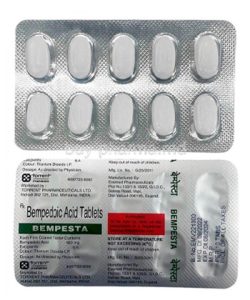
In brief
- Bempedoic acid is normally a prescription-only (Rx) medicine in Australia and most other markets and is supplied through pharmacies (brands include Nexletol/Nilemdo/Nexlizet/Nustendi); note that some pharmacies or online sellers may offer it without a prescription or receipt, but obtaining prescription medicines that way is not recommended, may be illegal and carries safety risks.
- Bempedoic acid is used to lower LDL‑cholesterol in primary hypercholesterolaemia and mixed dyslipidaemia, either as an add‑on to maximally tolerated statin therapy or for statin‑intolerant patients; it works by inhibiting ATP citrate lyase (ACL), a different enzyme to those targeted by statins.
- The usual adult dose is 180 mg orally once daily (the fixed combination with ezetimibe is 180 mg/10 mg once daily when greater LDL‑C reduction is required).
- Administered orally as a film‑coated tablet (180 mg alone or 180 mg/10 mg in the fixed‑dose combination).
- Biochemical effects on LDL‑C may begin to appear within a couple of weeks, but clinical reassessment of lipid reduction is typically performed at 4–12 weeks.
- The drug is taken once daily and its pharmacologic action is maintained with daily dosing (approximately 24‑hour dosing interval); LDL‑C lowering is sustained with ongoing treatment.
- There is no specific absolute alcohol prohibition, but avoid heavy alcohol intake and use caution if you have liver disease because bempedoic acid can raise liver enzymes; alcohol may worsen hepatic risks.
- The most common side effect is increased uric acid (hyperuricaemia); other frequent adverse effects include muscle spasms, back or limb pain, upper respiratory tract infections, abdominal pain, diarrhoea, fatigue and elevated liver enzymes.
- Would you like to try bempedoic acid without a prescription?
Availability & Price Landscape
Basic Bempedoic Acid Information
- INN (International Nonproprietary Name): Bempedoic acid
- Brand Names Available In Australia: Nexletol (180 mg) and Nexlizet (180 mg/10 mg) marketed with distribution support from Esperion Therapeutics and CSL Seqirus; Nilemdo/Nustendi are other regional brand names managed by Daiichi Sankyo in Europe and related territories.
- ATC Code: C10AX21
- Forms & Dosages: Film-coated tablets 180 mg (monotherapy) and 180 mg/10 mg fixed combination with ezetimibe.
- Manufacturers In Australia: Esperion Therapeutics (originator) with distribution partnership via CSL Seqirus; Daiichi Sankyo holds European licences for Nilemdo/Nustendi.
- Registration Status In Australia: Approved and marketed via national distribution arrangements; local ARTG/sponsor details should be checked before listing (not specified in the supplied data).
- OTC / Rx Classification: Prescription only (Rx) in major markets.
Which suppliers stock bempedoic acid in Australia and how pricing looks in practice is a key concern for patients.
| Purchase Channel | Typical In-Store Availability | Online Availability & Delivery |
|---|---|---|
| National Pharmacy Chains (Chemist Warehouse, Priceline, TerryWhite) | Commonly stock prescription lipid therapies; may hold limited stock of Nexletol/Nexlizet or order from distributor | Often available via in‑store order or networked stock with same‑day to 2–3 day pickup in metro areas |
| Regional/Rural Pharmacies | May rely on supplier distribution or patient special order; risk of delays or temporary stockouts | Courier delivery common; allow extra days for rural locations |
| Online Pharmacies / Telehealth Services | Not applicable | E‑prescription and courier options; pricing may vary and delivery typically 9–21 days for discrete parcels |
Major suppliers into Australia include Esperion Therapeutics (originator), CSL Seqirus (local distributor/licence partner) and Daiichi Sankyo for some regional licences.
Typical pack formats are tablets in blisters; explicit pack sizes are not specified in the supplied data and vary by market and distributor.
Price sensitivity is high in Australia, and patients commonly compare private script pricing across chains or consider cross‑border suppliers when PBS subsidy does not apply.
Patient Insights & Satisfaction Levels
Which experiences do Australians report when starting bempedoic acid?
Forum reviews on ProductReview and heart‑health groups commonly highlight useful LDL‑C reductions for people who cannot tolerate statins.
Many patients note once‑daily dosing and perceived better muscle tolerability compared with high‑dose statins.
Some users report clearer results when bempedoic acid is combined with ezetimibe, reflecting the fixed‑dose Nexlizet/Nustendi option.
- Top Patient‑Reported Pros: measurable LDL reduction, once‑daily convenience, tolerability in some statin‑intolerant patients, useful as an adjunct to statins, benefit when combined with ezetimibe, clear monitoring schedule recommended by pharmacists.
- Top Patient‑Reported Cons: gout flares or higher uric acid, muscle aches in a minority, gastrointestinal upset, cost concerns, access delays in rural areas, occasional tendon discomfort.
Statin‑intolerant is commonly defined in discussion forums as inability to tolerate at least two statins because of reproducible adverse effects such as myalgia or raised liver enzymes.
Rural patients often describe relying on courier delivery and facing occasional stockouts, whereas urban patients more frequently access same‑day pharmacy supplies from national chains.
Pharmacist counselling quality is repeatedly praised when it includes clear advice on checking uric acid and liver enzymes and on stepwise switching or combining treatments.
Product Overview & Brand Variants
What brands and formulations are available in Australia and internationally?
Bempedoic acid is the INN and is marketed in Australia primarily as Nexletol (monotherapy 180 mg) and Nexlizet (180 mg/10 mg fixed combination with ezetimibe) via Esperion and distribution support from CSL Seqirus.
Daiichi Sankyo markets Nilemdo and Nustendi in Europe and other territories under licence arrangements.
| Brand | Strength | Manufacturer | Pack Size |
|---|---|---|---|
| Nexletol | 180 mg | Esperion Therapeutics / CSL Seqirus (Australia) | Not specified |
| Nexlizet | 180 mg / 10 mg | Esperion Therapeutics / CSL Seqirus (Australia) | Not specified |
| Nilemdo | 180 mg | Daiichi Sankyo Europe | Not specified |
| Nustendi | 180 mg / 10 mg | Daiichi Sankyo Europe | Not specified |
All formulations are film‑coated tablets, available as 180 mg monotherapy and 180/10 mg fixed‑dose combination with ezetimibe.
The product is prescription‑only and regulated by the Therapeutic Goods Administration in Australia; check ARTG and sponsor details before listing on a public pharmacy product page.
For product pages, emphasise originator/manufacturer details (Esperion; Daiichi Sankyo) and note approvals in the US and EU as supporting global use data.
Indications In Local Medical Practice
Which patients in Australia are likely to be offered bempedoic acid?
TGA‑aligned indications position bempedoic acid as an adjunct to diet and maximally tolerated statin therapy for adults needing additional LDL‑C lowering, and as an option for statin‑intolerant patients.
In routine practice, clinicians commonly use bempedoic acid in three scenarios: inadequate LDL control despite statin ± ezetimibe, documented statin intolerance, and as a step before PCSK9 inhibitors when cost or access limits injectable use.
- Prescribing Checklist: confirm current lipid therapy, document statin intolerance where relevant, assess baseline lipids and liver enzymes, and consider uric acid testing if gout history is present.
Off‑label patterns vary but include temporary use while investigating statin adverse effects and combination with lower‑dose statins or separate ezetimibe prescriptions outside the fixed‑dose product.
Local prescribing emphasises baseline testing and a follow‑up lipid review at 4–12 weeks, with uric acid monitoring where clinically indicated.
How It Works In The Body
How does bempedoic acid lower cholesterol in plain terms?
Bempedoic acid works by reducing the liver’s ability to make cholesterol, which encourages the liver to remove more LDL from the bloodstream.
Because it acts upstream of the statin target, patients often hear it described as a non‑statin pill that helps lower bad cholesterol.
Clinically, bempedoic acid is an ATP citrate lyase (ACL) inhibitor that reduces hepatic cholesterol synthesis upstream of HMG‑CoA reductase, statins’ enzyme target.
The drug is a prodrug activated in the liver with minimal activation in skeletal muscle, a feature thought to reduce the risk of myalgia compared with statins in some patients.
LDL‑C reductions are typically measured at 4–12 weeks after initiation and are additive when combined with ezetimibe in fixed‑dose products such as Nexlizet.
Important safety‑relevant pharmacology includes a tendency to raise uric acid in some patients and the need for monitoring liver and renal function as clinically indicated.
Dosage & Administration
How should patients take bempedoic acid and what monitoring is needed?
The usual adult dose is 180 mg orally once daily for monotherapy, and fixed‑dose combination tablets are available as 180 mg/10 mg bempedoic acid/ezetimibe once daily.
Tablets may be taken with or without food.
- Start — Monitor — Adjust — When To Stop:
- Start: 180 mg once daily.
- Monitor: lipid panel at baseline and reassess at 4–12 weeks; check LFTs and renal function as clinically indicated; measure uric acid if there is gout history.
- Adjust: no routine dose change for elderly; use caution in severe renal impairment (eGFR <30) and moderate hepatic impairment.
- Stop: discontinue for pregnancy, breastfeeding, severe hepatic impairment or serious adverse events (tendon rupture, severe muscle symptoms).
There is no established paediatric dosing, and the medicine is not recommended for children.
If a dose is missed, take it when remembered unless it is close to the next scheduled dose; do not double up.
Overdose management is supportive with monitoring for adverse effects, particularly muscle symptoms.
Contraindications & Side Effects
What should patients watch for and when should they seek urgent care?
Absolute contraindications include known hypersensitivity to bempedoic acid or excipients, and pregnancy and breastfeeding because safety data are lacking.
Use with caution in patients with severe renal or hepatic impairment, a history of gout or hyperuricaemia, and prior tendon disorders.
- Common Side Effects: increased uric acid/hyperuricaemia, muscle spasms, back or limb pain, upper respiratory tract infection, abdominal pain, diarrhoea, fatigue, and modest transaminase elevations.
- Rare But Serious: tendinopathy or tendon rupture, severe hepatic injury and clinically significant gout flares.
Red flags that require immediate medical review include sudden severe tendon pain or swelling, new severe muscle pain with weakness, jaundice or dark urine, and severe gout attacks.
Pharmacists should counsel patients to stop the medicine and seek urgent assessment if they experience any of those red flags, and to report adverse events to the TGA.
Comparable Medicines
How does bempedoic acid compare with other lipid‑lowering options available under PBS and privately?
| Medicine | Route | Typical LDL‑C Effect | PBS Status (General Note) | Pros / Cons |
|---|---|---|---|---|
| Atorvastatin / Rosuvastatin | Oral | Large LDL‑C reductions | Widely PBS‑subsidised for many indications | Pros: robust outcome data, low cost; Cons: some patients intolerant to high doses. |
| Ezetimibe | Oral | Moderate LDL‑C reduction alone; additive with statin | Often PBS‑accessible depending on indication | Pros: oral, low cost; Cons: smaller LDL‑C effect than PCSK9 inhibitors. |
| Bempedoic Acid (Nexletol / Nexlizet) | Oral | Moderate reduction as monotherapy; additive with ezetimibe | PBS listing varies by formulation and indication | Pros: once‑daily oral, option for statin‑intolerant patients; Cons: raises uric acid, less LDL lowering than PCSK9 inhibitors, PBS access may be limited. |
| PCSK9 Inhibitors (Alirocumab, Evolocumab) | Injectable | Large LDL‑C reductions | PBS access usually restricted to specialist approval | Pros: strong LDL‑C lowering; Cons: injectable, higher cost, access hurdles. |
Choice depends on LDL target, tolerance, cost and PBS eligibility, with bempedoic acid offering an oral, statin‑sparing option for selected patients.
Current Research & Trends
What are the research priorities and recent trial highlights for bempedoic acid?
Major trial programmes since approval have focused on cardiovascular outcomes, combination strategies with ezetimibe, and use in statin‑intolerant populations.
Recent analyses to 2025 emphasise LDL‑C reductions and tolerability, while ongoing studies and registries continue to examine hard cardiovascular endpoints and subgroup benefits such as in chronic kidney disease and elderly patients.
Australian registries and real‑world studies are assessing tolerability, rural access barriers and comparative cost‑effectiveness versus PCSK9 inhibitors.
Emerging trends include interest in fixed‑dose combination products like Nexlizet/Nustendi and positioning bempedoic acid as a statin‑sparing adjunct when escalation to injectables is not feasible or affordable.
Common Patient Questions
- Will This Replace My Statin? It is commonly used as an adjunct to maximally tolerated statin therapy, and may be used as an alternative in documented statin‑intolerant patients.
- How Quickly Will My Cholesterol Fall? Expect to reassess LDL at about 4–12 weeks after starting therapy to judge response.
- Any Monitoring Needed? Baseline and periodic liver function tests and lipid panels are standard; check uric acid if there is a history of gout; renal monitoring as clinically required.
- Can I Take It With Other Drugs? Interactions are limited; ezetimibe combinations are available as fixed‑dose tablets for convenience.
- Is It On The PBS? PBS listing varies by indication and formulation; confirm current listings before counselling on cost and consider special‑authority pathways if appropriate.
- What Side Effects Should I Watch For? Report new tendon pain, severe muscle pain, signs of liver dysfunction or gout flares urgently.
Pharmacist prompts for consultation include verifying pregnancy risk, documenting statin intolerance, advising on storage and missed‑dose rules, and discussing private script cost pathways if PBS does not apply.
Regulatory Status
Where is bempedoic acid approved and how is it regulated in Australia?
Bempedoic acid products (marketed as Nexletol and Nexlizet in some markets) were approved by the FDA in the United States in February 2020 and by the EMA for Europe in April 2020, and are supplied into Australia through arrangements involving Esperion Therapeutics, CSL Seqirus and Daiichi Sankyo depending on region.
| Region | Approval Year | Brand Names | Sponsor |
|---|---|---|---|
| United States | 2020 | Nexletol | Esperion Therapeutics |
| European Union | 2020 | Nilemdo / Nustendi | Daiichi Sankyo Europe |
| Australia / New Zealand | Not specified | Nexletol / Nexlizet | Esperion / CSL Seqirus (distribution arrangements) |
The product is classified as prescription‑only in major markets and TGA regulation governs registration and ARTG listing in Australia; pharmacy teams must confirm current ARTG and PBS details before advising patients.
Maintain records of prescribing authority when required and report suspected adverse events to the TGA’s database to support post‑marketing safety surveillance.
Visual Recommendations
What visuals help a patient understand bempedoic acid on a product page?
Recommended design elements include a cost pathway infographic comparing PBS versus private pricing, a branded tablet image and blister photograph with dosage callouts, and a pharmacy‑network map to show same‑day pickup versus courier options for urban and rural customers.
Other useful visuals are a simple mechanism‑of‑action diagram showing ACL inhibition leading to LDL reduction, a compact contraindications stop box for quick reading, and a monitoring timeline graphic covering baseline to 4–12 weeks and ongoing checks.
For SEO and accessibility, supply alt text such as “Nexletol 180 mg tablet Australia” and use structured data for product and price where possible.
Buying & Storage Advice
How should Australians buy and store bempedoic acid safely?
Patients obtain bempedoic acid from community and hospital pharmacies or via accredited online pharmacy services that accept e‑prescriptions and telehealth scripts.
In our online pharmacy, bempedoic acid is available without a prescription, with discreet delivery to Australia in 9-21 days.
When ordering, verify sponsor and batch details (Esperion, CSL Seqirus or Daiichi Sankyo depending on the pack) and inspect pack integrity on receipt.
- At Home Storage Checklist: store between 15–30°C, protect from moisture, keep in original blister and out of reach of children.
- Travel Tips: keep tablets in original pack, avoid leaving medication in parked vehicles, and protect from heat and humidity common in Australian summers.
If a pack is exposed to extreme heat or humidity, advise patients to contact the supplying pharmacy for replacement guidance.
Guidelines For Proper Use
What should pharmacists include in counselling and safety checks?
A pharmacist counselling checklist should confirm indication and prior lipid history, review current lipid‑lowering therapy and statin tolerance, document allergies and gout history, advise baseline labs and schedule a 4–12 week follow‑up lipid review.
Provide written action points for adverse events and use the sponsor’s consumer medicine information when handing out printed materials.
Patient safety recommendations include warning about pregnancy and breastfeeding contraindication, giving missed‑dose instructions and advising immediate review for tendon pain, severe muscle pain or signs of liver dysfunction.
For pharmacists, maintain pharmacovigilance reporting to the TGA, liaise with the patient’s GP or cardiologist where lipid targets are not met, and document counselling in the patient’s medication profile.
Delivery Across Australia
| City | Region | Delivery time |
|---|---|---|
| Sydney | New South Wales | 9-14 days |
| Melbourne | Victoria | 9-14 days |
| Brisbane | Queensland | 9-14 days |
| Perth | Western Australia | 9-14 days |
| Adelaide | South Australia | 9-14 days |
| Canberra | Australian Capital Territory | 9-14 days |
| Hobart | Tasmania | 9-14 days |
| Darwin | Northern Territory | 9-14 days |
| Gold Coast | Queensland | 9-14 days |
| Newcastle | New South Wales | 9-14 days |
| Wollongong | New South Wales | 9-14 days |
| Geelong | Victoria | 9-14 days |
| Townsville | Queensland | 14-21 days |
| Cairns | Queensland | 14-21 days |
| Sunshine Coast | Queensland | 14-21 days |