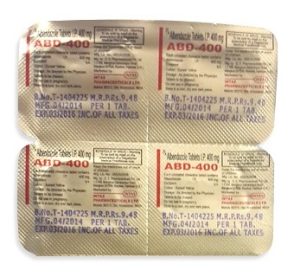
Albendazole
In brief
- Albendazole can be purchased from pharmacies and e-pharmacies in Australia, and in some settings it may be available without a prescription; however, it is generally a prescription medicine for human use.
- Albendazole is used to treat worm infections such as roundworm, pinworm, hookworm, whipworm, taeniasis, strongyloidiasis, neurocysticercosis, and hydatid disease. It is an anthelmintic (benzimidazole) that works by inhibiting parasite microtubule formation and glucose uptake, leading to parasite death.
- The usual dose depends on the infection: 400 mg as a single dose for common intestinal worms; 400 mg once daily for 3 days for some infections; and 15 mg/kg/day in two divided doses for more serious tissue infections, with a maximum of 800 mg daily.
- Albendazole is taken by mouth as an oral tablet, chewable tablet, or oral suspension.
- It usually starts working within a few hours, although symptom improvement and parasite clearance may take longer depending on the type of infection.
- The duration of action varies by indication: a single dose may be enough for minor intestinal infections, while treatment may continue for 3 days or several weeks in conditions such as neurocysticercosis or echinococcosis.
- Alcohol should be avoided or limited during treatment, as both alcohol and albendazole can place extra strain on the liver.
- The most common side effects are nausea, vomiting, abdominal pain, diarrhoea, headache, and dizziness; some people may also experience raised liver enzymes or temporary hair loss.
- Would you like to try albendazole without a prescription?
Basic Albendazole Information
- INN (International Nonproprietary Name): Albendazole
- Brand Names Available In Australia: Zentel, Albenza, Eskazole, Albendazol Labormed, Albendazol Medley, Albendazol Neo Quimica, Albendazol MK, Zenzera, Zestaval, Zolben
- ATC Code: P02CA03
- Forms & Dosages: Oral tablet 200 mg and 400 mg, chewable tablet 200 mg and 400 mg, oral suspension 100 mg/5 mL, 200 mg/5 mL, 400 mg/10 mL
- Manufacturers In Australia: Not specified
- Registration Status In Australia: Not specified
- OTC / Rx Classification: Prescription (Rx) in most countries for human formulations
What Shoppers See First In Australia, And What Patients Usually Ask For
Looking for a worm tablet often starts with price, stock, and brand names, not the parasite name.
That is especially true in Australia, where shoppers compare national pharmacy chains, online listings, and whatever is actually on the shelf that day.
In city pharmacies, people usually ask for albendazole tablets by brand, while rural patients are more likely to ask what the pharmacist can supply quickly and safely.
National Pharmacy Chains And Discount Pricing
Big chains such as Chemist Warehouse, Priceline, and TerryWhite Chemmart often shape price expectations before a patient even speaks to a pharmacist.
Discount pricing can make an antiparasitic medicine Australia shoppers recognise feel simple to buy, but the label still needs checking for strength, pack size, and whether the product is for human use.
Rural Versus Urban Access, And Why Pharmacist Advice Matters
In metro areas, stock replacement is often easier, but in regional and remote areas, a suitable pack may need to be ordered in.
That is where pharmacist advice matters, because the right tablet strength, repeat dose timing, and referral to a doctor can save time and reduce mistakes.
Online Listings, E-Prescriptions, And Stock Variability
Online searches may show Zentel 400 mg, Albendazole 400 mg tablet, Albendazole 200 mg, or even Albenza, but the local supply can change with TGA registration and wholesaler availability.
Some human formulations are prescription medicines in most countries, while veterinary products sit in a different category and should not be used in people.
In our online pharmacy, albendazole is available without a prescription, with discreet delivery to Australia in 9-21 days.
| Common Search Term | What It Usually Means | Australian Buying Note |
|---|---|---|
| Zentel 400 mg | Albendazole tablet | Availability may vary by stock |
| Albendazole 400 mg tablet | Human oral tablet | Check pack size before ordering |
| Albenza | Global brand name | Brand familiarity does not guarantee local supply |
| Albendazole suspension | Liquid oral form | Useful where tablets are not suitable |
What Albendazole Is, And Which Product Versions Buyers May Recognise
Wondering whether albendazole is the same as the “worm tablets” people talk about at the pharmacy counter?
It is the active ingredient, not just one brand, and that is why labels can look different from country to country.
- Albendazole
- An anthelmintic active against gastrointestinal and tissue parasites.
- ATC code P02CA03
- The WHO and EMEA code for albendazole as a benzimidazole derivative.
- Zentel
- A widely recognised global brand, including 400 mg tablets and a 10 mL suspension containing 400 mg.
- Albenza
- A US and global brand available in 200 mg and 400 mg tablets.
- Valbazen
- A veterinary product and not a human medicine.
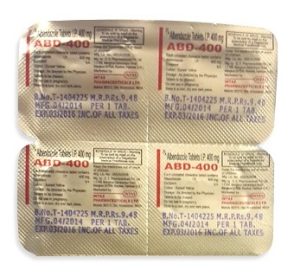
Packaging can be as small as one or two tablets in a blister, or a suspension in a small bottle.
That is why shoppers looking for Zentel albendazole, albendazole chewable tablet, or albendazole tablets should always check the pack carefully before buying.
Which Worm Infections Albendazole Is Used For In Practice
Trying to work out whether a single tablet is enough, or whether a longer course is needed, is a common pharmacy question.
The answer depends on the parasite involved and whether it is a simple intestinal infection or a deeper tissue infection.
| Condition | Typical Adult Dose | Practical Notes |
|---|---|---|
| Ascariasis | 400 mg single dose | Repeat in 2 to 3 weeks if needed |
| Trichuriasis | 400 mg single dose | Repeat in 2 to 3 weeks if needed |
| Hookworm | 400 mg single dose | Repeat in 2 to 3 weeks if needed |
| Enterobiasis | 400 mg single dose | Repeat in 2 to 3 weeks if needed |
| Strongyloidiasis | 400 mg once daily | 3 days |
| Taeniasis | 400 mg once daily | 3 days |
| Hymenolepiasis | 400 mg once daily | 3 days, repeat after 3 weeks if needed |
| Neurocysticercosis | 15 mg/kg/day, max 800 mg, in 2 divided doses | Specialist-directed treatment |
| Echinococcosis | 15 mg/kg/day, max 800 mg, in 2 divided doses | Specialist-directed treatment in cycles |
Simple intestinal worm infections often use a short course, while neurocysticercosis and echinococcosis need much closer medical supervision.
Off-label use is also described for some protozoal infections and cutaneous larva migrans, but that is not the same as routine over-the-counter self-treatment.
How Albendazole Works, In Plain English
If someone asks how a worm tablet actually works, the short answer is that it stops the parasite functioning properly.
Albendazole is active against gastrointestinal and tissue parasites, so it does more than just “flush out” worms.
Worm takes in albendazole → parasite can’t keep feeding properly → worm weakens and dies → the body clears it over time
That is why some people notice improvement fairly quickly, while others need repeat dosing or a longer course.
It also explains why a single tablet may be enough for common intestinal worms, but not for infections sitting in tissue.
Why Worms Stop Feeding And Die
At pharmacy level, the practical message is simple: the medicine is meant to kill the parasite, not just ease symptoms.
For that reason, it is important to follow the dose for the correct infection and not assume one product suits every situation.
Why It Works Better For Some Parasites Than Others
Albendazole works best where the parasite is accessible to the medicine and susceptible to its action.
Deep tissue infections may need repeat courses because the organism load is higher and treatment is harder to complete.
Clinical Mechanism, Absorption, And Why Food Can Matter
People often want to know whether they should take albendazole with food, and why some regimens are far longer than one day.
That is a fair question, especially when a packet looks like a straightforward worm tablet but the instructions read very differently.
Albendazole is a benzimidazole derivative, and that drug class is used to target parasites rather than bacteria or viruses.
Its treatment plans can range from a single dose to prolonged specialist courses, which is why product information and monitoring advice matter.
| Clinical Point | Why It Matters |
|---|---|
| Absorption and metabolism | Affects how much medicine reaches the parasite and how the regimen is planned |
| Food considerations | Can be relevant in practice because treatment response depends on exposure |
| Longer regimens | Used for neurocysticercosis and echinococcosis, where treatment may run for 8 to 30 days or in 28-day cycles with 14-day intervals |
For neurocysticercosis, product information also notes corticosteroids and antiepileptics may be used alongside albendazole.
That is not a casual pharmacy-counter problem and should be managed by a doctor.
Available Dosage Forms, Strengths, And Pack Sizes Australians May Encounter
Looking at the wrong strength is one of the easiest ways to make a simple treatment confusing.
That is why product form matters just as much as the brand name on the front of the box.
| Dosage Form | Strength | Typical Packaging |
|---|---|---|
| Oral tablet | 200 mg, 400 mg | Blister of 1 to 10 tablets, bottle |
| Chewable tablet | 200 mg, 400 mg | Blister pack |
| Oral suspension | 100 mg/5 mL, 200 mg/5 mL, 400 mg/10 mL | 10 mL, 20 mL, or 30 mL bottles |
Pack size affects price because smaller blister packs and speciality suspensions can cost differently from standard tablets.
That is why a customer asking for albendazole 200mg, Zentel 200mg tablets, or an albendazole chewable tablet may see more than one option online.
Standard Dosing By Condition: What Label-Style Guidance Looks Like
People usually want the quick version first: how much, how often, and for how long?
That is exactly where dosing tables help, because the answer changes with the infection being treated.
| Condition | Adult Dose | Duration |
|---|---|---|
| Ascariasis, trichuriasis, hookworm, enterobiasis | 400 mg single dose | Repeat in 2 to 3 weeks if needed |
| Strongyloidiasis | 400 mg once daily | 3 days |
| Taeniasis | 400 mg once daily | 3 days |
| Hymenolepiasis | 400 mg once daily | 3 days, repeat after 3 weeks if needed |
| Neurocysticercosis | 15 mg/kg/day, maximum 800 mg, in 2 divided doses | 8 to 30 days, with corticosteroids and antiepileptics as directed |
| Echinococcosis | 15 mg/kg/day, maximum 800 mg, in 2 divided doses | 28 days per course, 3 cycles with 14-day intervals |
For many common intestinal worms, a single 400 mg dose is the standard adult approach.
Specialist conditions need a different mindset, because the dosing is closer to a structured treatment plan than a one-off worm treatment.
Dosing Adjustments And Special Populations Australians Ask About
Questions about children, pregnancy, liver disease, and breastfeeding come up all the time at the counter.
That is where it helps to be very clear about what is known and what is not established.
- Children
- Children over 2 years use the same dosing as adults, while safety and efficacy are not established under 2 years.
- Elderly
- No specific adjustment is listed, but hepatic function should be monitored.
- Hepatic impairment
- Use with caution and monitor liver function tests; active liver disease is a contraindication.
- Renal impairment
- Generally no adjustment is needed, but data are limited in severe impairment.
- Breastfeeding
- Caution is advised.
That means the answer is not always “yes” or “no” for every household.
It is often “check the patient’s medical history first”.
Side Effects People Actually Notice, From Mild To Urgent
Most shoppers want reassurance that the medicine is usually straightforward.
That reassurance is fair, but it should come with honest symptom checking so minor effects are not ignored.
- Common and usually self-limiting: nausea, vomiting, abdominal pain, diarrhoea, headache, dizziness, fever, reversible hair loss, raised transaminases.
- More serious and needs medical review: pancytopenia, severe hepatic injury.
- Worth mentioning at the counter: any ongoing stomach upset, unusual tiredness, jaundice, easy bruising, or symptoms that feel out of proportion to a simple worm tablet.
At the pharmacy, clear counselling often stops a patient from abandoning treatment too early.
It also helps distinguish a predictable upset stomach from a reaction that needs urgent follow-up.
Who Should Not Take It: Contraindications, Interactions, And Red Flags
Some medicines are easy to buy but not easy to use safely in every person.
Albendazole is one of those medicines, especially when liver disease or pregnancy is involved.
Do not use if there is known hypersensitivity to albendazole or other benzimidazoles, pregnancy especially in the first trimester, or active liver disease or notable liver enzyme elevation.
- Relative cautions: liver impairment, bone marrow suppression or cytopenias, breastfeeding, and cysticercosis involving the eyes.
- Why eye involvement matters: parasite death can risk retinal damage.
- When referral is essential: any suspected ocular disease, neurological symptoms, or treatment planned for hydatid disease or neurocysticercosis.
These are the cases where a pharmacist should slow the conversation down and make sure the patient sees the right clinician.
How Albendazole Compares With Other Antiparasitic Options In Australian Pharmacies
Shoppers often compare albendazole with mebendazole, ivermectin, and praziquantel because those names come up in different treatment conversations.
The useful question is not which one sounds familiar, but which one fits the infection.
| Medicine | Typical Role | Where Albendazole Fits |
|---|---|---|
| Mebendazole | Common worm treatment | Albendazole may be chosen when broader parasite coverage or a different regimen is needed |
| Ivermectin | Used for some helminths | Albendazole remains important for several intestinal and tissue parasites |
| Praziquantel | Tapeworms and flukes | Albendazole is not the same medicine and is not interchangeable for every parasite |
Albendazole is used in mass deworming campaigns and sits on the WHO Essential Medicines List, which is a strong confidence signal for many shoppers.
For Australian buyers, PBS status may vary by product and indication, so private-script and discount-pharmacy pricing is often the real-world comparison point.
Regulatory Status And Global Approval Signals Shoppers Trust
Many patients feel more comfortable when they recognise a medicine from overseas.
That is understandable, but local supply still depends on Australian regulatory status and stock.
| Region | Status | Brand Example |
|---|---|---|
| USA | FDA-approved | Albenza |
| EU | Approved by EMA | Various brands |
| Romania | Registered with ANMDMR | Albendazol Labormed |
Human formulations are prescription-only in most countries, while some veterinary forms may be sold differently.
International brand familiarity can help a shopper recognise the medicine, but TGA availability is what matters for Australian supply.
Buying Advice In Store, Online, And Through Telehealth Scripts In Australia
Most people just want the medicine in hand without turning the process into a project.
That is reasonable, especially when symptoms are uncomfortable and family members may need treatment too.
- Check the label: look for Albendazole 400 mg tablet, Albendazole 200 mg, Zentel 400 mg, or Albenza, and confirm it is for humans.
- Use reputable channels: Australian customers commonly compare Chemist Warehouse, Priceline, TerryWhite Chemmart, and telehealth e-prescriptions.
- Ask about substitution: generic and brand changes can alter appearance, but not necessarily the active ingredient.
- Avoid veterinary products: Valbazen is for animals and should not be used in humans.
A quick pharmacist conversation can save a lot of confusion, especially when a family is trying to treat multiple people at once.
It also helps make sure the chosen albendazole tablets match the infection and the person using them.
Storage, Missed Doses, And Safe-Use Guidance For Households
A worm medicine stored badly is still a medicine, but it may not be one you want to trust for later use.
That matters in Australian homes where heat, moisture, and family access can all create problems.
- Store correctly: keep at 15 to 30°C, tightly closed, protected from light and moisture.
- Use the original pack: this helps with identification and transport.
- Avoid freezing: do not leave it in cold storage that might damage the product.
- Keep away from children: tablets and suspensions should not be left in reach.
If a dose is missed, take it as soon as you remember unless it is almost time for the next dose.
Do not double up.
If an overdose is suspected, urgent medical care is needed because gastrointestinal and neurological effects may occur and treatment is supportive.
| City | Region | Delivery Time |
|---|---|---|
| Sydney | New South Wales | 9-14 days |
| Melbourne | Victoria | 9-14 days |
| Brisbane | Queensland | 9-14 days |
| Perth | Western Australia | 9-14 days |
| Adelaide | South Australia | 9-14 days |
| Canberra | Australian Capital Territory | 9-14 days |
| Hobart | Tasmania | 9-14 days |
| Darwin | Northern Territory | 9-14 days |
| Gold Coast | Queensland | 14-21 days |
| Newcastle | New South Wales | 14-21 days |
| Wollongong | New South Wales | 14-21 days |
| Geelong | Victoria | 14-21 days |
| Townsville | Queensland | 14-21 days |
| Albury | New South Wales | 14-21 days |
For families, the practical goal is simple: keep the pack stored safely, follow the dose exactly, and ask for help early if the symptoms, age, or medical history make the case more complicated.